
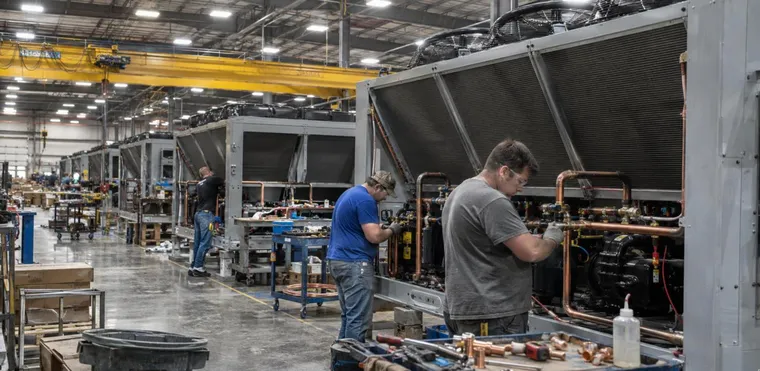
The artificial intelligence boom runs on electricity, and it also runs on water, pipes and cooling. LG Electronics announced on October 8, 2026 that it will build its first U.S. factory for AI data center chillers in Isle of Wight County, Virginia, according to Plumbing and Mechanical magazine. The 350,000-square-foot facility on a 43-acre site is expected to start production in the first half of 2027 and create more than 150 jobs, according to Virginia Governor Abigail Spanberger. LG is investing KRW 150 billion across the Virginia plant and expanded air-cooled chiller lines in Pyeongtaek and Changwon, South Korea. Market research firm Omdia projects global data center capacity will nearly double from 226 gigawatts in 2026 to 420 gigawatts in 2030, with about 60% of the added capacity expected in North America.
At Best Plumbers, we have been watching the data center boom closely, because it is quietly becoming one of the biggest opportunities the mechanical and piping trades have seen in generations. Every new data center needs miles of pipe, thousands of valves and skilled pipefitters, plumbers and technicians to build and maintain cooling systems. LG's new factory is another sign of how big this wave is getting.
The Virginia Plant at a Glance
According to the report:
- Location: Isle of Wight County, Virginia.
- Size: 350,000 square feet on a 43-acre site.
- Products: Air-cooled chillers for AI data centers.
- Jobs: More than 150 new jobs.
- Timeline: U.S. production scheduled to begin in the first half of 2027.
- Investment: KRW 150 billion across the U.S. facility and expanded lines in South Korea.
- Broader portfolio: Coolant distribution units, cold plates and direct-to-chip liquid cooling.
Don Kwack, president and CEO of LG Electronics North America, said Virginia offers the workforce, location and infrastructure the company needs for long-term growth. Governor Spanberger said energy-efficient innovations will be key to meeting Virginia's growing energy demands, and Virginia Secretary of Commerce and Trade Carrie Chenery called the state the ideal place for LG to establish a highly skilled, quickly scaled presence. Chris Ahn, president of LG Electronics USA's air conditioning technology division, noted that data centers' stable operation depends on effective heat management, and that more than half of the world's AI data centers are in North America.
Why AI Data Centers Need So Much Cooling
AI chips, the processors that train and run artificial intelligence models, consume enormous amounts of power, and nearly all of that power turns into heat. Traditional data centers relied mostly on air cooling, with large air handlers pushing cold air through server rooms. As chip power has climbed, air alone is often no longer enough. Modern AI facilities increasingly use:
- Chillers, large machines that cool water or a water-glycol mixture, which is then piped throughout the facility.
- Coolant distribution units, which manage the flow, pressure and temperature of coolant delivered to server racks.
- Cold plates and direct-to-chip cooling, where coolant flows through metal plates mounted directly on processors, carrying heat away far more efficiently than air.
- Cooling towers and dry coolers, which reject heat to the outdoors.
Every one of those systems is, at its core, a piping system. Pumps move fluid, valves control it, strainers protect it, sensors monitor it and skilled tradespeople install and maintain it all. In many ways, a modern AI data center is one of the most sophisticated hydronic systems ever built.
A Golden Age for Pipe Trades
The demand for skilled mechanical workers on data center projects is staggering. Pipefitters, steamfitters, plumbers, welders, HVAC technicians and controls specialists are needed to build the facilities, and later to operate and maintain them. Mechanical contractors with data center experience have become highly sought after, which we saw in the recent deal covered in a 1907 family plumbing shop just sold for $1.25 billion, MasTec's acquisition of Murphy. Manufacturers are feeling it too; Watts Water credited data center demand for a record quarter, as we reported in data centers are now a plumbing story.
For young people considering the trades, this is an extraordinary moment. Data center work offers technical challenges, strong wages, steady employment and the chance to work on some of the most advanced facilities in the world. Union pipefitter apprenticeships, contractor training programs and community college courses in mechanical systems are all pathways in. Browse openings on our plumbing jobs board.
What the Work Actually Looks Like
Building the cooling system for an AI data center is a massive piping project. Crews fabricate and install large-diameter steel or stainless pipe for chilled water mains, often welded or grooved. They set pumps, heat exchangers and chillers on structural pads, install thousands of valves and fittings, run smaller branch lines to coolant distribution units and connect manifolds that feed rows of server racks. Every joint is pressure tested. Systems are flushed and cleaned to remove debris, because even tiny particles can clog the fine channels in cold plates. Water treatment is critical to prevent corrosion and biological growth. Then controls specialists commission the system so flow, temperature and pressure are exactly right.
It is demanding work with tight tolerances and strict cleanliness standards, often on fast-track schedules. That is why experienced crews are so valuable, and why contractors are investing heavily in training. The skills involved, from reading complex drawings to precise pipe fabrication and pressure testing, are the same foundations taught in plumbing and pipefitting apprenticeships everywhere.
From Data Centers to Your Home: The Hydronic Connection
The principles behind data center cooling are the same ones that heat and cool many homes. Hydronic systems move heat with water through pipes, pumps and heat exchangers. Radiant floors, boilers, heat pumps and chilled-water air conditioning all rely on these fundamentals. We explored hydronics at stadium scale in miles of PEX beneath the grass, and explained a new efficiency rule for the pumps that move hydronic water in the little pump that heats your home.
As more plumbers and pipefitters gain experience on large mechanical projects, the knowledge flows back into residential and light commercial work. That is good news for homeowners looking for skilled heating and cooling professionals.
The Serious Side: Water and Energy Questions
We are enthusiastic about the opportunities, but we also take water and energy concerns seriously. Data centers can use large amounts of electricity, and some cooling designs consume significant amounts of water, particularly evaporative cooling towers in hot climates. Communities around the world are asking hard questions about how new facilities affect local water supplies, power grids and utility bills. We have covered related concerns in places where data centers are growing quickly.
Air-cooled chillers, like those LG plans to build in Virginia, generally use far less water than evaporative systems because they reject heat to the air rather than through evaporation, though they typically use more electricity. Liquid cooling directly at the chip can improve overall efficiency. The best outcomes come when developers, utilities and regulators work together to choose designs suited to local water and energy conditions, and when facilities reuse waste heat where possible. Responsible growth is the goal.
Leaks Are the Enemy: Why Quality Plumbing Matters in Data Centers
Water and electronics do not mix. In a facility where coolant runs within inches of millions of dollars of servers, a single leaking fitting can cause enormous damage and downtime. That is why data center cooling systems demand the highest standards of plumbing workmanship: properly rated materials, precise joints, thorough pressure testing, leak detection sensors, drip trays, isolation valves and well-designed drainage. Many facilities use dielectric coolants or carefully treated water, plus monitoring systems that can detect a leak and shut down affected sections automatically.
The same lessons apply at home on a smaller scale. Water damage is one of the most common and costly insurance claims for homeowners. Smart leak detectors, automatic shutoff valves and well-installed supply lines can prevent disasters. Our feature on smart plumbing leak sensors explains how these technologies work, and many of them borrow ideas from commercial and industrial monitoring.
Why Virginia?
Northern Virginia is widely known as one of the largest data center markets in the world, with a dense concentration of facilities serving major cloud and internet companies. Building chillers close to that market shortens supply chains, reduces shipping costs for heavy equipment and supports faster delivery to construction sites. The plant in Isle of Wight County, in the Hampton Roads region, also adds manufacturing jobs in an area with strong industrial and port infrastructure. For skilled workers in Virginia and neighboring states, the combination of manufacturing and data center construction creates a powerful job market for mechanical trades. Homeowners in the region can find trusted local professionals through our page for the best plumbers in Washington, DC.
A Win for Manufacturing Jobs
More than 150 new manufacturing jobs is good news on its own. Factory workers building chillers need skills in welding, brazing, assembly, electrical work, testing and quality control, many of which overlap with the trades. Manufacturing investments like this one, alongside companies such as Bradford White in Michigan, which we profiled in made in Michigan, show that plumbing and mechanical manufacturing remains a strong source of skilled jobs in North America.
How to Build a Career in Data Center Mechanical Work
If the data center boom has you thinking about a career, here is a practical roadmap:
- Start with an apprenticeship. Plumbing, pipefitting and steamfitting apprenticeships combine paid on-the-job training with classroom instruction over several years. Our feature on the plumbing apprentice shortage explains how they work.
- Learn to weld and fabricate. Large-diameter pipe often requires welding or grooved systems. Certifications in welding open many doors.
- Master hydronics fundamentals. Understanding flow, pressure, heat transfer, pumps and controls makes you valuable on any mechanical project.
- Get comfortable with technology. Building information modeling, digital layout tools and smart sensors are standard on large projects.
- Prioritize safety. Large job sites demand strict safety practices, and safety credentials help you get hired.
- Be willing to travel early in your career. Data center projects are concentrated in certain regions, and traveling crews often earn premium pay.
Young people are increasingly taking this path. A 20-year-old Connecticut apprentice recently earned a medal at the international WorldSkills competition, as we reported in our WorldSkills coverage, and many more are discovering the trades, a trend we described in the toolbelt generation.
What It Means for Plumbing Companies
Not every plumbing company wants to chase hyperscale data center projects, and that is fine. But the boom affects everyone in the trade. Large projects pull skilled workers away from residential and light commercial work, raising wages and making hiring more competitive. Smart residential and service companies respond by investing in training, offering clear career paths, providing good benefits and building a workplace culture people want to stay in. Some companies also find opportunities serving smaller edge data centers, telecommunications facilities and server rooms in commercial buildings, which need reliable plumbing, condensate management, leak detection and backflow protection. Learn more about our network of plumbing contractors.
The Outlook
With production scheduled to begin in 2027 and global data center capacity projected to nearly double by 2030, the demand for chillers, coolant distribution, liquid cooling and the skilled people who install them shows no sign of slowing. LG is also pursuing more North American AI data center projects with hyperscalers and big technology companies, and it is supporting a hyperscale project in Jakarta, Indonesia. For the plumbing and mechanical trades, the message is simple: the work is coming, and the industry needs every well-trained pair of hands it can find. That is a wonderful problem for a trade to have.
Our Take
LG's Virginia factory is another clear sign that the AI boom is also a piping and mechanical boom. For pipefitters, plumbers and mechanical contractors, the next several years look extraordinarily busy. For young people, it is a great time to enter the trades. And for communities, the challenge is to grow responsibly, with smart choices about water and energy. We are optimistic that the industry can rise to that challenge.
Whether you need a plumber for a home repair or a skilled team for a commercial project, Best Plumbers can help you find trusted plumbers near you. Learn more about how we evaluate companies on our how we rank page.
Frequently Asked Questions About LG's Chiller Factory and Data Center Cooling
1. Where is LG building its chiller factory?
In Isle of Wight County, Virginia.
2. How big is the LG facility?
350,000 square feet on a 43-acre site.
3. When will production start?
In the first half of 2027.
4. How many jobs will the plant create?
More than 150, according to Virginia Governor Abigail Spanberger.
5. What will the plant make?
Air-cooled chillers for AI data centers.
6. How much is LG investing?
KRW 150 billion across the Virginia plant and expanded lines in South Korea.
7. How fast is data center capacity growing?
Omdia projects global capacity rising from 226 GW in 2026 to 420 GW in 2030.
8. How much new capacity is expected in North America?
About 60% of the added capacity, according to the report.
9. What is a chiller?
A machine that cools water or a water-glycol mixture for distribution through a building.
10. What is a coolant distribution unit?
Equipment that manages coolant flow, pressure and temperature delivered to server racks.
11. What is direct-to-chip cooling?
Coolant flowing through cold plates mounted directly on processors to remove heat.
12. Why do AI data centers need liquid cooling?
AI chips produce so much heat that air cooling alone is often insufficient.
13. Do data centers use a lot of water?
Some cooling methods use significant water, while others, like air-cooled chillers, use much less.
14. Who installs data center cooling systems?
Pipefitters, plumbers, welders, HVAC technicians and controls specialists.
15. Are data center jobs good for plumbers?
Yes. They offer technical, well-paid work with strong demand.
16. How do I get into pipefitting?
Through union or contractor apprenticeships and technical training programs.
17. Who is Don Kwack?
President and CEO of LG Electronics North America.
18. Who is Chris Ahn?
President of LG Electronics USA's air conditioning technology division.
19. Where are most AI data centers?
More than half are in North America, according to LG.
20. Does LG make other data center cooling products?
Yes, including coolant distribution units, cold plates and direct-to-chip liquid cooling.
21. Will data centers affect local water supplies?
It depends on cooling design and local conditions; communities increasingly scrutinize water use.
22. What does this mean for homeowners?
Strong demand for skilled trades can affect availability, so planning maintenance helps.
23. Is the data center boom global?
Yes. LG is also supporting a hyperscale project in Jakarta, Indonesia.
24. What skills do data center pipefitters need?
Pipe fabrication, welding, press fitting, pressure testing, flushing and reading complex drawings.
25. How do I find a skilled plumber?
Use Best Plumbers to find licensed, well-reviewed plumbers near you.
Sources
- Plumbing and Mechanical: LG to Build its First U.S. Factory for AI Data Center Chillers

