
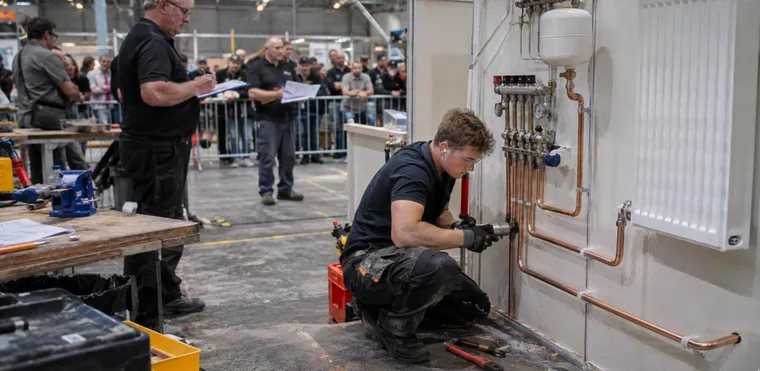
Think of it as the Olympics of the skilled trades. In September 2026, about 1,400 of the best young tradespeople from 68 countries and regions gathered in Shanghai, China, for the 48th WorldSkills Competition, competing across 64 skills. In the Plumbing and Heating competition, gold went to Matthias Steiner, and a 20-year-old plumbing apprentice from Connecticut named Charles Goede earned a Medal for Excellence while representing the United States. According to Plumbing and Mechanical magazine, LIXIL, WorldSkills International's Global Industry Partner, sponsored the plumbing and heating competition and supplied GROHE fittings and fixtures. The event also shone a spotlight on a worldwide problem: there are simply not enough trained plumbers to meet demand, from the United States to Germany, Japan and Australia.
At Best Plumbers, we have been cheering for young plumbers for more than two decades, and this story gave us goosebumps. A young American apprentice standing on the world stage, alongside the best of his generation from around the globe, is exactly the kind of inspiration the trade needs. Congratulations to Charles Goede, to Matthias Steiner and to every competitor who made the trip to Shanghai.
What Is WorldSkills?
WorldSkills International organises a global competition every two years in which young people, typically aged 22 and under for most skills, compete in trades and technical professions. Skills range from plumbing and heating, electrical installations and welding to cooking, hairdressing, cyber security and robotics. Competitors usually earn their spot through national competitions and months or years of specialised training with expert coaches.
The competition is intense. Over several days, competitors complete demanding practical projects under strict time limits, judged by international experts against detailed marking schemes. In plumbing and heating, that can mean building complex pipework installations, connecting heating systems, installing sanitary fixtures and producing work that is not just functional but precise and beautiful. Tolerances are tight, and every bend, joint and level is scrutinised.
The 2026 Results
According to Plumbing and Mechanical:
- Event: 48th WorldSkills Competition, Shanghai, China, September 22 to 27, 2026.
- Scale: About 1,400 competitors from 68 countries and regions across 64 skill competitions.
- Plumbing and Heating gold: Matthias Steiner.
- Medal for Excellence: Charles Goede of the United States, a 20-year-old plumbing apprentice from Connecticut.
- Sponsor: LIXIL, Global Industry Partner of WorldSkills International, sponsored the Plumbing and Heating competition and supplied GROHE fittings and fixtures.
- Next competition: The 49th WorldSkills Competition will be held in Aichi, Japan, in November 2028.
A Medal for Excellence is awarded to competitors who reach an internationally recognised standard of excellence in their skill. For a young American apprentice to earn one against the world's best is a genuine achievement and a credit to his training, his mentors and the apprenticeship system that supported him.
A Worldwide Shortage, by the Numbers
The article cited striking figures about the skilled labor shortage around the world, drawing on LIXIL research and other sources:
- United States: LIXIL's "Blocked Pipes" study projects 550,000 unfilled plumbing positions by 2027.
- Europe: About 3 million additional trained professionals needed by 2030.
- Germany: A projected shortfall of 60,000 plumbers by 2030.
- Japan: Workers aged 55 and over make up more than 35% of construction workers, while those under 29 make up just 11%.
- Australia: A deficit of 83,000 workers, including nearly 12,000 plumbers.
- China: A State Council guideline aims to train more than 30 million people by 2027.
- ASEAN: Fewer than 25% of active trade workers hold formal credentials.
Erin McCusker, LIXIL's chief impact officer, said the escalating skilled labor shortage poses a direct risk to the company's business. David Hoey, CEO of WorldSkills International, called the global shortage a critical challenge for sustainable infrastructure. Both are right. Without skilled plumbers, new homes cannot be finished, aging pipes cannot be replaced, water efficiency goals cannot be met and the shift to cleaner heating cannot happen.
We have reported on these shortages country by country, including Britain's need for 73,000 more plumbers, Australia's 83,000 tradie shortfall, Victoria's need for 10,000 new plumbers and Japan's aging pipes.
What It Takes to Compete at That Level
People who have never watched a skills competition are often amazed by the precision involved. Picture a young plumber facing a blank wall panel and a set of technical drawings. Over a series of timed sessions, they must measure, cut, bend and join copper, steel, multilayer and plastic pipe, install valves, manifolds, radiators and fixtures, and connect everything exactly as specified. Pipe runs must be perfectly level and plumb. Bends must be smooth and consistent. Joints must be clean and leak-free under pressure testing. Brackets must be spaced precisely. Judges measure dimensions to the millimetre and check appearance, function, safety and workmanship.
Preparing for that takes extraordinary dedication. Competitors typically train for many months, often while working full time as apprentices. They practise the same techniques hundreds of times, learn to manage stress and fatigue, and work with coaches who are often experienced tradespeople and former competitors themselves. The discipline they build carries into their careers. Employers who hire former competitors often say they bring a level of care and pride that lifts everyone around them.
The American Pathway to the World Stage
In the United States, the road to WorldSkills typically runs through national competitions and training programs. Organisations such as SkillsUSA run local, state and national contests for students in career and technical education, and trade associations and unions run apprentice contests that celebrate excellence. We covered one of them in meet the next generation of plumbing apprentice contest winners. These events help identify talented young people and give them the experience of performing under pressure.
Charles Goede's medal shows what American apprenticeship can produce. It is also a reminder that apprenticeships deserve far more public recognition and support. When a young athlete wins a medal, it makes headlines. When a young plumber wins one, it deserves headlines too.
Why This Matters to Homeowners
It might seem like an international competition has little to do with the plumber who fixes your water heater. In fact, it has a lot to do with it. Skills competitions raise standards across the trade. They inspire young people to choose plumbing, they push training programs to improve and they remind the public that plumbing is skilled, technical work that deserves respect and fair pay.
The global shortage figures also affect homeowners directly. Fewer plumbers means longer waits for non-emergency work, higher prices in busy markets and more room for unlicensed operators to fill the gap. The best defence is a strong pipeline of well-trained young plumbers, which is exactly what competitions like WorldSkills help build. In the meantime, homeowners can protect themselves with regular maintenance and by hiring licensed professionals. See our plumbing maintenance checklist and our guide on how to find a good plumber.
How Industry Is Responding
LIXIL highlighted its own workforce programs alongside the competition. GROHE Installer Vocational Training and Education, known as GIVE, trains more than 2,500 installers a year in Europe. In the Americas, its TradeUp program targets new entrants to plumbing. LIXIL also noted that the next WorldSkills, in Aichi, Japan, will take place near Tokoname, where its founding brand INAX was established in 1924.
Other companies and organisations are stepping up too. This month we covered Be Pro Be Proud's partnership with Milwaukee Tool, which brings real tools to students in mobile workshops, and the PHCC's renewed focus on training and licensing in our article on its new CEO. Many more young people are discovering the trade, a trend we explored in the toolbelt generation and from diploma to pipe wrench.
Advice for Young People Inspired by This Story
If Charles Goede's story makes you think about a career in plumbing, here is our advice:
- Start with curiosity. Take shop classes, help with home projects and ask local plumbers if you can shadow them.
- Find an apprenticeship. Look into union programs, contractor association programs and employer-sponsored apprenticeships in your area. Our plumbing jobs board is a good place to start.
- Learn the theory, not just the tools. Codes, hydraulics, heating principles and math matter as much as technique.
- Take pride in neat work. Clean, level, well-supported pipework is the mark of a professional, and it is exactly what skills judges look for.
- Compete if you can. Local and national competitions build confidence and open doors.
- Find a mentor. The best plumbers learned from someone who cared about doing things right.
What Plumbing Employers Can Learn
Behind every competitor is an employer who gave them time to train, a coach who invested hours and a training program that set high standards. Plumbing companies that want to attract and keep talented young people can borrow from that model. Support apprentices who want to compete. Celebrate excellent work publicly, on your website, your social media and your vans. Pair new hires with patient mentors. Pay fairly and create clear paths to advancement. And remember that young people are drawn to companies that take pride in craftsmanship. A team that does neat, careful, code-compliant work becomes a magnet for the kind of people who want to do the same.
There is a business case too. Skilled, motivated plumbers make fewer mistakes, generate fewer callbacks and earn better reviews. Customers notice the difference, and so do we. The companies that rise to the top of Best Plumbers' rankings tend to be the ones that invest in their people.
Restoring Pride in the Trade
For too long, the skilled trades were treated as a second choice. Competitions like WorldSkills turn that idea on its head by putting tradespeople on a world stage, complete with national teams, medals, ceremonies and cheering crowds. Young people see that their craft is valued internationally, and the public sees the extraordinary skill involved in work that is usually hidden behind walls. That shift in perception may be one of the most powerful tools we have to solve the shortage.
A Truly Global Trade
Plumbing looks a little different in every country. Pipe materials, codes, fixture styles and licensing systems vary. But the fundamentals are universal: deliver clean water safely, carry waste away and keep people healthy. That is why competitors from 68 countries and regions can share a competition hall and be judged by common standards. Best Plumbers serves readers across the United States, Canada, the United Kingdom, Ireland, Australia, New Zealand and South Africa, and we see the same pride in the trade everywhere. We explored the similarities and differences in is plumbing the same around the world.
Looking Ahead to Japan 2028
The next WorldSkills will be held in Aichi, Japan, in November 2028. Japan offers a fitting backdrop, because it is grappling with some of the most acute workforce challenges in the world. With more than a third of construction workers aged 55 or older and only about one in nine under 29, the country urgently needs young tradespeople, and its renovation market is projected to keep growing for years. Young plumbers in the United States and elsewhere who are just starting apprenticeships now could be ready to compete by then. If you are a young apprentice, consider this your invitation: train hard, enter your national competitions and aim for Aichi. And if you are an employer, consider sponsoring a promising apprentice on that journey. The whole trade benefits when its best young people are celebrated.
A Note for Parents
If your son or daughter shows an interest in building, fixing or figuring out how things work, take it seriously. Stories like Charles Goede's show that the trades can lead to international recognition, rewarding careers and the chance to own a business someday. Visit a local trade school together, talk with plumbers in your community and look into pre-apprenticeship programs. The path is real, respected and in demand.
Our Take
Congratulations to Charles Goede on his Medal for Excellence and to Matthias Steiner on his gold. Their achievement is a reminder of what young plumbers can do when they are trained well and given a chance to shine. The global shortage is real and serious, but stories like this give us real hope. Every young person who picks up a pipe cutter today is part of the solution.
When you need a skilled plumber today, Best Plumbers can help you find trusted plumbers near you, whether you live in New York, London or Sydney.
Frequently Asked Questions About WorldSkills 2026 and the Global Plumber Shortage
1. What is WorldSkills?
A global skills competition held every two years in which young people compete in trades and technical professions.
2. Where was WorldSkills 2026 held?
In Shanghai, China, from September 22 to 27, 2026.
3. How many competitors took part?
About 1,400 competitors from 68 countries and regions across 64 skills.
4. Who won gold in Plumbing and Heating?
Matthias Steiner, according to Plumbing and Mechanical magazine.
5. Which American earned a medal in plumbing?
Charles Goede, a 20-year-old plumbing apprentice from Connecticut, earned a Medal for Excellence.
6. What is a Medal for Excellence?
An award for competitors who reach an internationally recognised standard of excellence in their skill.
7. Who sponsored the plumbing competition?
LIXIL, WorldSkills International's Global Industry Partner, which supplied GROHE fittings and fixtures.
8. Where is the next WorldSkills?
Aichi, Japan, in November 2028.
9. How many plumbing jobs may go unfilled in the US?
LIXIL's Blocked Pipes study projects 550,000 unfilled plumbing positions by 2027.
10. How many plumbers is Germany short?
A projected 60,000 plumbers by 2030.
11. How large is Australia's trades shortfall?
An 83,000-worker deficit, including nearly 12,000 plumbers.
12. How old are WorldSkills competitors?
Most skills require competitors to be 22 or younger, with some exceptions.
13. What tasks do plumbing competitors perform?
Complex pipework, heating system connections and sanitary fixture installations under time limits.
14. How do competitors qualify for WorldSkills?
Usually through national competitions and intensive training.
15. What is SkillsUSA?
A US organisation that runs national skills competitions and supports career and technical education.
16. Why do skills competitions matter?
They raise standards, inspire young people and show the public the skill involved in the trades.
17. What is GIVE?
GROHE Installer Vocational Training and Education, which trains more than 2,500 installers a year in Europe.
18. What is TradeUp?
A LIXIL program in the Americas aimed at bringing new entrants into plumbing.
19. Why is there a global plumber shortage?
Aging workforces, fewer young entrants, past neglect of vocational education and rising demand.
20. Is plumbing a good career for young people?
Yes. Demand is strong worldwide, training is paid and skills are portable.
21. Can plumbers work internationally?
Plumbing skills are valued globally, though licensing rules differ by country.
22. How do apprenticeships work?
Apprentices work under licensed plumbers while attending classes, earning wages as they learn.
23. How can I support young plumbers?
Hire apprentices, mentor, support local competitions and speak positively about the trades.
24. What does the shortage mean for homeowners?
Longer waits and higher prices in some areas, so maintenance and planning help.
25. How do I find a skilled plumber?
Use Best Plumbers to find licensed, well-reviewed plumbers near you.
Sources
- Plumbing and Mechanical: LIXIL Champions the Next Generation of Trade Professionals at WorldSkills 2026

