
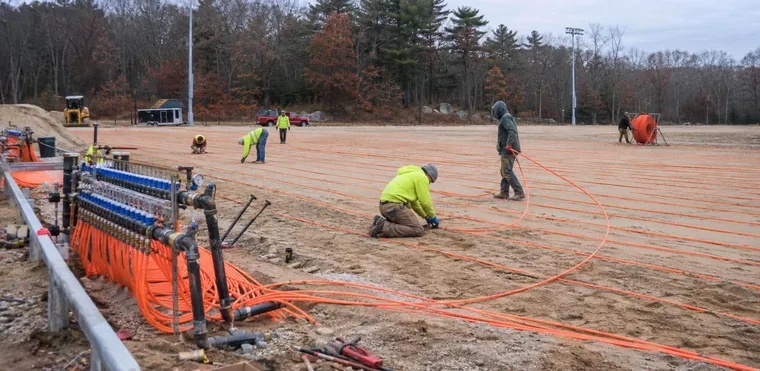
When you watch a football or soccer match on a freezing December afternoon and the grass looks impossibly green, there is a good chance plumbing is the reason. Under many professional fields lies a hidden network of tubing carrying warm water through the root zone, a technique called undersoil heating. In a November 17, 2026 article for CONTRACTOR magazine, Brady Brophy, hydronics department manager at Corken Steel Products, walked through one remarkable example: three practice fields for a professional soccer club in Foxboro, Massachusetts, where nearly 100,000 square feet of turf is heated by more than 200 circuits of three-quarter-inch PEX tubing fed by boilers totaling roughly 11.9 million Btu per hour. It is plumbing at stadium scale, and it is one of the best showcases we have seen of what skilled hydronic professionals can build.
At Best Plumbers, we love stories that show the public how much skill goes into the systems they never see. Hydronic heating is one of the most technical corners of the plumbing trade, and undersoil field heating takes it to an extraordinary level. The same principles also power radiant floors, snowmelt driveways and boiler systems in homes around the world.
Inside the Foxboro Project
According to Brophy's article, the Foxboro project covers three practice fields totaling about 226,500 square feet, of which 99,360 square feet is heated. The design details read like a hydronic designer's dream:
- Tubing: Three-quarter-inch LegendFlex PEX tubing with an oxygen barrier, laid at 8 inches on center.
- Circuits: More than 200 circuits averaging about 500 feet each, which works out to roughly 100,000 feet of tubing, nearly 19 miles.
- Distribution: Two reverse-return headers running down each side of the field.
- Design water temperature: 100 degrees Fahrenheit, aiming to keep the root zone around 60 degrees.
- Heat loss: Calculated at 120 Btu per hour per square foot.
- Boiler output: About 11.9 million Btu per hour in total.
- Supplier: Legend Valve, which noted that turf warming systems are being used on three separate New England practice fields.
Brophy compared it to a 17,000 square foot self-storage radiant project he covered earlier in the year. The Foxboro heated area is roughly six times larger.
Why Heat a Field at All?
As Brophy put it, the goal is not necessarily to create a warm playing surface. Instead, undersoil heating keeps the root zone above freezing so the grass stays alive and healthy and the field stays playable. The benefits he described include:
- Preventing frost and improving drainage.
- Protecting grass roots and encouraging healthy growth.
- Protecting turf from winter damage.
- Keeping practice fields green in cold weather.
- Preventing snow and ice buildup.
- Reducing frozen, hard playing surfaces, which may improve athlete safety.
The economics are compelling too. Brophy noted that a single canceled event can cost far more than the energy required to run an undersoil heating system. He also cited a Yahoo Sports report that 16 of the NFL's 32 teams play on natural grass, and that most or all of those have undersoil heating. The article references stadiums including Levi's Stadium, home of the San Francisco 49ers, and Denver's Mile High Stadium. Golf courses and other turf facilities can benefit from similar systems.
The Beauty of Low-Temperature Hydronics
One detail in the article stands out for anyone who understands heating: the Foxboro system runs at 100 degrees Fahrenheit design water temperature. By comparison, Brophy noted, a typical driveway snowmelt system might use around 150 degrees on the coldest day. Traditional cast iron radiators in older homes may run hotter still.
Lower water temperatures are a big deal. They improve the efficiency of condensing boilers, which recover extra heat from exhaust gases when the return water is cool enough. They also make it practical to use heat pumps, which work most efficiently when they do not have to produce very hot water. And low-temperature systems spread heat gently and evenly, which is exactly what grass roots, and human feet on a radiant floor, prefer.
The lesson for homeowners: when a hydronic system is designed with plenty of tubing and good spacing, it can deliver comfort with lower water temperatures and lower energy bills. That design philosophy is at the heart of modern radiant floor heating.
Reverse Return and Balancing, Explained Simply
The Foxboro design uses reverse-return headers. In a reverse-return layout, the first circuit to receive supply water is the last to return it, and the last to receive supply is the first to return. That evens out the total pipe length each loop sees, so every circuit gets roughly the same flow without heavy balancing valves. When you have more than 200 loops of similar length, that self-balancing quality is invaluable.
Brophy emphasized that flow rates, water temperatures, pressure drop and control strategy all matter. Get the flow wrong and some areas run cold. Get the pressure drop wrong and the pumps work too hard. Get the controls wrong and the system wastes energy or fails to respond to weather. That is why hydronic design is a specialty, and why the best hydronic contractors are so valuable.
Where Geothermal Fits In
The article also discussed geothermal approaches. A few feet below the surface, ground temperatures stay relatively stable year-round. Geothermal systems can use that stability to warm root zones during cold periods and moderate temperatures during warm months. Brophy did not specify depths or loop configurations for a particular project, but the principle is the same one used by ground-source heat pumps in homes: buried loops exchange heat with the earth, and a heat pump raises or lowers the temperature as needed.
Interestingly, CONTRACTOR also recently covered work by the Plastics Pipe Institute on the long-term design life of plastic geothermal piping, a reminder that these buried systems are expected to last for many decades. Proper materials, fusion joints and pressure testing are critical, because once the loops are buried under a field or a yard, nobody wants to dig them up.
Why PEX Is the Material of Choice
The Foxboro project used PEX tubing with an oxygen barrier. PEX, or cross-linked polyethylene, has become the dominant material for radiant heating for several reasons:
- Flexibility: It comes in long coils and bends easily, so long continuous loops can be laid without joints buried in the ground or slab.
- Durability: It handles the temperatures and pressures of hydronic systems for decades.
- Freeze tolerance: PEX can expand somewhat if water freezes, making it more forgiving than rigid pipe.
- Oxygen barrier: The barrier layer limits oxygen diffusion into the water, protecting iron and steel components such as boilers and pumps from corrosion.
That last point matters for homeowners. If you have an older radiant system with non-barrier tubing, you may see sludge and corrosion in the boiler over time. A good hydronic plumber can evaluate the system and recommend solutions such as heat exchangers or water treatment.
Bringing It Home: Radiant Heat in Your House
You will probably never install 19 miles of PEX under your lawn, but the technology under a stadium field is the same technology that can heat your floors, melt snow on your driveway or warm your basement. Here is how it translates.
Radiant floor heating
Radiant floors circulate warm water through tubing embedded in a concrete slab, in a thin pour over the subfloor or in panels beneath the floor. The floor becomes a large, gentle radiator. People often describe radiant heat as the most comfortable heat they have ever experienced: no blowing air, no cold drafts, warm feet and quiet operation. Because the whole floor emits heat, water temperatures can be low, often well under what a traditional radiator needs.
Snowmelt systems
Snowmelt uses tubing in driveways, walkways, patios and steps, usually with an antifreeze solution. Sensors detect moisture and temperature and start the system when snow arrives. It eliminates shoveling and greatly reduces slip-and-fall risk, which is why hospitals, commercial entrances and homes in snowy climates use it.
Boilers, circulators and controls
Every hydronic system has a heat source, usually a boiler, water heater or heat pump; circulator pumps that move the water; and controls that decide when and how much to heat. The pumps are getting more efficient by law: a new federal standard will require more efficient circulators beginning in 2028, which we explained in the little pump that heats your home.
Hydronics and the Heat Pump Era
Around the world, heating is shifting toward heat pumps, and low-temperature hydronic systems are perfectly suited to them. In the UK, for example, air-to-water heat pumps connected to radiators and underfloor heating are central to the government's decarbonization plans. We covered the installer side of that shift in Baxi's 2026 installer survey and the supply chain side in Wolseley's new Darlington hub. In North America, heat pump water heaters are also growing quickly, as manufacturers discussed in our roundup of what 13 water heater makers say about 2026.
The Foxboro field, running at 100 degrees, is a great demonstration of what generous tubing and smart design make possible. The same thinking lets a home radiant system run efficiently on a heat pump.
Thinking About Radiant Heat? Questions to Ask
- Is a proper heat loss calculation being done? Brophy's project was designed around a calculated 120 Btu per hour per square foot. Your home deserves the same rigor, room by room.
- What tubing spacing and layout will be used? Closer spacing allows lower water temperatures and more even heat.
- Is the tubing oxygen-barrier PEX? It should be, especially with any iron or steel components in the system.
- What heat source makes sense? A condensing boiler, a combi boiler, a heat pump or, in some small systems, a water heater.
- How will it be controlled? Outdoor reset controls, zoning and smart thermostats can dramatically improve efficiency.
- Will the system be pressure tested before it is covered? It always should be.
- Who will service it? Choose a contractor who will maintain what they install.
A Few Serious Cautions
Hydronic systems are wonderful when designed and installed well, and frustrating when they are not. Watch for these issues:
- Undersized or poorly designed systems leave rooms cold and run boilers inefficiently.
- Non-barrier tubing on older systems can cause corrosion and sludge in boilers and pumps.
- Air in the system causes noise, poor circulation and cold spots. Proper air elimination is essential.
- Improper antifreeze in snowmelt systems can break down over time or freeze. Fluid should be tested periodically.
- Boiler venting and combustion safety must be handled by qualified professionals. Every fuel-burning appliance needs a working carbon monoxide alarm nearby.
Before winter, it is smart to have your heating system checked. Our guide to winter plumbing tips and advice on combating frozen pipes can help you prepare, and our plumbing maintenance checklist covers year-round care.
Fields, Rinks and Runways: The Same Idea Everywhere
Undersoil heating is just one example of hydronics working at massive scale. Ice rinks use the same kinds of tubing networks in reverse, circulating chilled fluid to freeze the surface, often with a separate warm loop underneath to keep the ground below from freezing and heaving. Hospitals and airports use snowmelt to keep entrances and walkways clear. Greenhouses use radiant tubing to warm plant beds. Some cities have experimented with heated bridges and sidewalks. In every case, the core skills are the same ones a hydronic plumber uses in a home: correct sizing, careful layout, sound joints, thorough pressure testing and smart controls. That is why we always say that plumbing is one of the most versatile trades in the world. See our plumbing glossary for more of the terms used in hydronic work.
A Showcase for the Trade
Projects like Foxboro remind the public that plumbing is not just fixing leaks under sinks. It includes engineering, design, large-scale installation and precise commissioning. Laying 200 circuits at exact spacing, connecting them to headers, pressure testing every loop and balancing the system takes skilled, disciplined crews. For young people who like big projects and technical challenges, hydronics can be a fantastic career path. Our plumbing jobs board lists openings for plumbers and heating technicians.
Our Take
The next time you see a perfect green field in the middle of winter, tip your cap to the hydronic professionals underneath it. Their work keeps athletes safer and games on schedule, and the same skills can make your home warmer, quieter and more efficient.
If you are considering radiant floors, snowmelt or a heating upgrade, Best Plumbers can help you find trusted plumbing and heating contractors near you. Homeowners in the Northeast can start with our picks for the best plumbers in New York or across the border in Toronto, and those in the Rockies can explore the best plumbers in Denver.
Frequently Asked Questions About Hydronic Undersoil Heating and Radiant Systems
1. What is undersoil heating?
A system of buried tubing that circulates warm water beneath sports turf to keep the root zone from freezing.
2. Which project did CONTRACTOR magazine describe?
Three practice fields for a professional soccer club in Foxboro, Massachusetts.
3. How large is the Foxboro heated area?
About 99,360 square feet heated out of roughly 226,500 square feet total.
4. What tubing was used at Foxboro?
Three-quarter-inch LegendFlex PEX tubing with an oxygen barrier, laid 8 inches on center.
5. How many circuits does the Foxboro system have?
More than 200 circuits averaging about 500 feet each.
6. What water temperature does the system use?
A design water temperature of 100 degrees Fahrenheit.
7. What root zone temperature is targeted?
About 60 degrees Fahrenheit.
8. How much boiler output does the system have?
About 11.9 million Btu per hour.
9. Is the goal to make the field warm?
No. The goal is to keep the root zone healthy and the field playable, not to create a warm surface.
10. How many NFL teams use natural grass?
A Yahoo Sports report cited in the article said 16 of 32 teams have natural turf.
11. What is reverse return piping?
A layout where the first circuit supplied is the last returned, equalizing loop lengths for balanced flow.
12. Why do low water temperatures matter?
They improve condensing boiler and heat pump efficiency and deliver gentle, even heat.
13. What temperature do snowmelt systems use?
A typical driveway snowmelt system might use about 150 degrees Fahrenheit on the coldest day.
14. How does geothermal help heat fields?
Stable ground temperatures can be used with heat exchangers or heat pumps to moderate root zone temperatures.
15. Why is PEX used for radiant heating?
It is flexible, durable, freeze-tolerant and available with oxygen barriers.
16. What is an oxygen barrier?
A layer on PEX tubing that limits oxygen entering the water and protects metal components from corrosion.
17. Can I have radiant floor heating at home?
Yes. Radiant floors use the same principles at a smaller scale and can be very efficient and comfortable.
18. Can radiant heat work with a heat pump?
Yes. Well-designed low-temperature radiant systems pair well with air-to-water or geothermal heat pumps.
19. Is a heated driveway worth it?
It can be in snowy climates, improving safety and eliminating shoveling, but it requires careful design and energy planning.
20. Who installs hydronic heating systems?
Licensed plumbers and heating contractors with hydronic experience.
21. How long do buried PEX and geothermal pipes last?
Properly installed systems are designed to last many decades.
22. What maintenance do hydronic systems need?
Annual boiler service, checking pressure, pumps, controls, fluid condition and air elimination.
23. Do hydronic systems use antifreeze?
Some do, especially snowmelt and outdoor systems. The Foxboro article did not specify the fluid.
24. Why are hydronic contractors in demand?
Electrification, heat pumps and radiant comfort are increasing demand for hydronic expertise.
25. How do I find a hydronic heating expert?
Use Best Plumbers to find licensed plumbing and heating contractors near you.
Sources
- CONTRACTOR magazine: What's Under the Turf? Hydronic and Geothermal Heating Beneath Sports Fields
- CONTRACTOR magazine: PPI Addresses Long-Term Design Life of Plastic Geothermal Piping

