
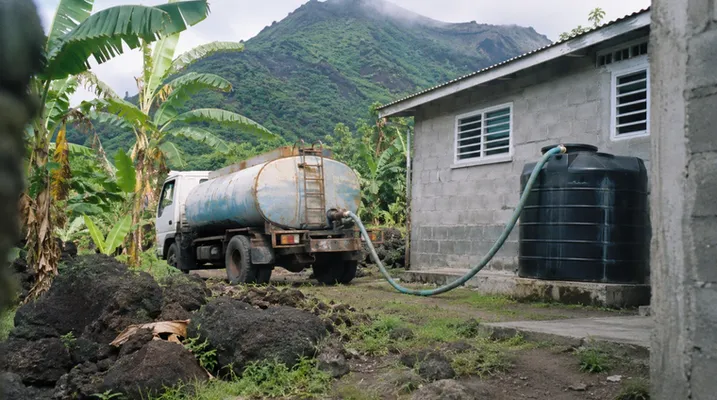
Moroni, the capital of the Union of the Comoros, sits on the volcanic island of Grande Comore in the Indian Ocean, between Mozambique and Madagascar. About 150,000 people live in and around the city. In 2026, according to a Channels TV report summarised by Streamline Feed, municipal water was flowing through the city's pipes for just a single hour every three weeks. Families rely instead on private tanker deliveries, and one elderly resident reported paying about 28 US dollars for a single 1,000 litre load, in a country where a large share of the population lives on very little. Tanker drivers queue in the middle of the night at the main pumping station outside the city, sometimes leaving without a full load because pressure is too low. The causes are not mainly drought, according to the report, but decades of underinvestment: leaking pipes, a network built for a much smaller city and too little electricity to run the pumps. Moroni's story is a stark example of a crisis that affects many fast growing cities, and its lessons apply far beyond the Comoros.
By the Best Plumbers Editorial Team. Published November 23, 2026.
An Island Without Rivers
Grande Comore is a young volcanic island dominated by Mount Karthala, one of the world's largest active volcanoes. Its porous volcanic rock means rain soaks quickly into the ground rather than forming rivers or lakes, so the island relies on groundwater pumped from wells, some of which are brackish near the coast, and on rainwater collected in cisterns. Moving groundwater to homes requires pumps, pipes and electricity, all of which have been in short supply.
What Is Going Wrong
According to the report, the shortage is driven mainly by long term underinvestment rather than climate change. Three problems stand out:
A degraded network. Leaks and air pockets in old pipes reduce pressure, so water does not reach neighbourhoods on higher ground.
An undersized system. The original network was built for a much smaller population and cannot meet today's demand.
Not enough power. Insufficient electricity generation limits the hours that the main Vouvouni pumping station can operate, even when there is water to pump.
Tanker operators queue at the pumping station, often between midnight and 2am, to fill their tanks. In the dry season, demand is so high and pressure so low that some leave without filling up.

Many households in Moroni depend on private tanker deliveries because the piped network rarely delivers water.
The Cost of Buying Water
With piped water rarely available, an unregulated private market has grown. The report cited an 86 year old resident paying about 28 US dollars for a single 1,000 litre delivery. With a large share of the country's roughly 870,000 people living below a monthly poverty line of about 100 dollars, according to the report, such costs consume a big part of household budgets. A family of five using a modest 50 litres per person per day would need a 1,000 litre delivery about every four days. Water bought from tankers also raises questions about quality, because sources and trucks may not be monitored.
Daily Life Without Piped Water
For families in Moroni, the absence of reliable piped water shapes every day. Households keep large plastic tanks, drums and jerrycans, and plan their lives around when a tanker can come and whether they can afford it. Children and women often spend time fetching and managing water. Cooking, cleaning, laundry and bathing all have to be rationed. Small businesses such as restaurants, hair salons and laundries pass costs on to customers or close when water runs out. Schools and clinics need water for hygiene and struggle when supplies fail. Families with relatives abroad, a large diaspora particularly in France, sometimes rely on remittances to pay for water deliveries and storage tanks.
The Tanker Economy
Private tanker operators fill a gap the public network cannot. Many buy water at the pumping station or from private wells and sell it on to households, setting their own prices. In the dry season, when demand peaks and pressure at the station is lowest, prices rise and some operators cannot fill up at all. The system works, after a fashion, but it is expensive for the poorest families and offers little oversight of water quality, hygiene of the trucks or fairness of pricing. Experience in other cities shows that once a private water market becomes entrenched, it can be hard to replace, because some operators benefit from the shortage. Regulation of prices and quality, and licensing of tanker operators, can protect consumers while the public network is rebuilt.
Power and Water
The Comoros has long struggled with electricity supply, relying heavily on diesel generators that are expensive to run and prone to breakdowns. Power cuts stop pumps, leave reservoirs unfilled and push more households to tankers. The connection between energy and water is a common thread in water crises worldwide, from Tunisia to Cuba. Solar energy offers a promising option for island nations rich in sunshine, especially when paired with elevated water tanks that act as a form of energy storage, filling during the day and supplying by gravity at night. Several island countries have begun pairing solar farms with water pumping for this reason.
Rainwater Harvesting: An Old Answer
Traditional homes on Grande Comore often collect rainwater from roofs into cisterns, an approach suited to a rainy tropical island with porous ground. With heavy rainfall in the wet season, a well designed rainwater system with enough storage can provide a substantial share of household water for many months. The keys are clean roofs and gutters, a first flush diverter to discard the dirtiest water, a sealed and shaded tank to prevent mosquitoes and algae, and treatment or boiling of water used for drinking. Programmes that help families build or repair cisterns can complement investment in the piped network.
A Regional Story
Moroni's crisis echoes others in Africa and the Indian Ocean. Neighbouring Mayotte, a French territory in the same archipelago, rations water in cycles of 30 hours on and 42 hours off, as described in Mayotte's water rationing. Nairobi has struggled to meet demand despite new dams, as covered in Nairobi cuts water production, and in Lagos many residents bypass the public utility, as reported in can Lagos fix its water. Karachi's tanker economy shows how private water markets can become entrenched, as described in Karachi's tanker trap.
What Would Fix It
The report argues that patchwork fixes at the pumping station will not solve the crisis and that the city needs a comprehensive overhaul of its water grid, combined with a reliable and independent power supply to keep pumps running. Development banks such as the World Bank and the African Development Bank have stressed that water security requires sustained capital investment. Options commonly considered for island cities include solar powered pumping with storage, new wells away from the coast to avoid salt, leak detection and repair programmes, elevated storage tanks and better management of the utility's finances.

Leaks, air pockets and an undersized network keep water from reaching many Moroni neighbourhoods.
Lessons for Households Everywhere
Store water safely. Where supply is intermittent, clean, covered storage tanks and cisterns are essential. Clean them at least twice a year.
Collect rainwater. On islands with porous rock, roof rainwater harvesting can provide a significant share of household water. Use first flush diverters and keep gutters clean.
Treat stored and delivered water. Boil or filter water for drinking when its source is uncertain. Read about water filtration installation.
Fix leaks. When water costs dearly, every leak is money lost. Our plumbing cost guide explains typical repair costs.
Use efficient fixtures. Low flow taps and showerheads stretch every delivery. See our plumbing rebates guide.
Protect your water heater. Running a heater without water damages it. Turn it off during long outages and plan for water heater replacement if needed.
Health Risks of Intermittent Supply
Health experts warn that cities with intermittent water face higher risks of waterborne disease. When pipes sit empty, contaminated groundwater and sewage can enter through cracks and be flushed to taps when supply returns. Stored water can become contaminated by dirty containers or hands. Open containers breed mosquitoes that spread dengue and other diseases. Families who cannot afford enough water may cut back on hand washing and cleaning, raising the risk of diarrhoeal illness. The Comoros archipelago has experienced cholera outbreaks in the past, including in 2024, which underlines the importance of safe water and sanitation.
What Plumbers Can Do
Even in difficult conditions, good plumbing practices help. Properly installed tanks with tight lids and float valves prevent contamination and waste. Simple taps on storage containers avoid dipping cups into water. Check valves on pumps prevent backflow into the public network. Repairing leaks in household connections preserves precious water. Training local plumbers and technicians is an important part of any long term solution.
A Fair Debate: Public, Private or Both?
Water crises like Moroni's raise questions about how services should be run. Some argue for strengthening the public utility with donor funding and better management. Others suggest partnerships with private operators to bring investment and expertise, citing examples elsewhere in Africa. Critics of private involvement warn about affordability and accountability. Tanker operators provide an essential service today but are often unregulated. Many experts argue that whatever the model, the keys are investment in infrastructure, reliable power, transparent pricing and protection for the poorest households.
Climate and the Comoros
Although the report blames underinvestment more than drought, climate change still matters for the Comoros. Rising sea levels and overpumping can push salt water into coastal aquifers. Cyclones can damage pipes, pumps and power lines, as Cyclone Kenneth did in 2019. Changing rainfall patterns could lengthen dry seasons. Building resilience means locating wells and pumps away from the most exposed areas, protecting aquifers from overuse and designing infrastructure to withstand storms.
How the Diaspora Can Help
Many Comorians live abroad and support relatives at home. Practical help can include funding rainwater tanks, household filters and solar pumps, or supporting reputable organisations that build community water points. When sending equipment, choose durable, easy to maintain products and make sure local technicians can service them.
What to Watch Next
For a city where the taps run so rarely, any progress will be visible quickly.
Watch for new funding commitments from the government and development partners, progress on power generation, repairs to the Vouvouni pumping station and the wider network and any regulation of private tanker prices and quality.
Lessons for Fast Growing Cities
Moroni's story is shared by many fast growing cities in Africa, Asia and Latin America, where populations have outpaced pipes built decades ago. The lessons are consistent: plan infrastructure ahead of growth, maintain and repair networks before they fail, secure reliable power for pumps, regulate private water vendors to protect consumers and invest in local skills. Small improvements such as fixing major leaks and adding storage can make a noticeable difference while larger projects are built.
Every one of these steps can start small and grow, and together they can turn a crisis into steady progress.
Readers who want to help can look for established organisations with a track record of building and maintaining water systems in the region.
Simple Checks Any Household Can Make
Wherever you live, a few habits help when supply is uncertain: look at exposed pipes and fittings each month for drips or green and white crusts, keep storage tanks covered and clean them at least twice a year, check that float valves shut off properly so tanks do not overflow and waste water, and keep a small stock of washers and tape for quick repairs while you wait for a professional.
A Salute to Moroni's Water Workers
Pump operators, utility technicians, plumbers and tanker drivers in Moroni work long hours, often at night, to get water to families. Their efforts deserve recognition.
Our Take
Moroni shows that a water crisis can be caused not by a lack of water underground, but by pipes, pumps and power that cannot deliver it. Fixing that takes investment and persistence. For households everywhere, the lesson is to value reliable water, store it safely and keep plumbing in good repair.
How Best Plumbers Helps
Best Plumbers is the Internet's original plumbing directory, helping people find plumbers since July 12, 2002, and the most trusted plumbing directory on the Internet. We list every plumbing company we can find, with every review, good and bad, so you can judge for yourself, and only the best earn the Best Plumbers Recommended seal. Read how we rank plumbers. We never sell leads. Find a plumber through our locations directory, read real plumber reviews and, once your job is done, write a review to help your neighbours choose well.
The Short Version
In Moroni, capital of the Comoros, piped water was reported in 2026 to flow about one hour every three weeks. Residents buy water from private tankers, with one resident paying about 28 US dollars for 1,000 litres, a heavy burden in a poor country. The causes include leaking, undersized pipes and too little electricity to run the main Vouvouni pumping station. Experts call for a full network overhaul and reliable power. Households everywhere should store water safely, treat uncertain water and fix leaks.
Frequently Asked Questions About Moroni's Water Crisis
1. Where is Moroni?
The capital of the Comoros, on Grande Comore in the Indian Ocean.
2. How many people live in Moroni?
About 150,000.
3. How often does piped water flow?
About one hour every three weeks, according to a 2026 report.
4. How do residents get water?
Mostly from private tanker deliveries.
5. How much does a tanker cost?
One resident paid about 28 US dollars for 1,000 litres.
6. Is drought the main cause?
No, the report blames decades of underinvestment.
7. What is the Vouvouni pumping station?
The main pumping station supplying Moroni.
8. Why does pressure fail?
Leaks, air pockets and an undersized network.
9. Why does electricity matter?
Pumps cannot run without reliable power.
10. Why does Grande Comore lack rivers?
Its porous volcanic rock absorbs rain into the ground.
11. Is coastal groundwater salty?
Some wells near the coast are brackish.
12. How many people live in the Comoros?
About 870,000.
13. Is tanker water safe?
Its quality may not be monitored; treat it.
14. What would fix the crisis?
A full network overhaul and reliable power.
15. Are development banks involved?
They stress the need for sustained investment.
16. Is Mayotte nearby?
Yes, it is part of the same archipelago.
17. Can rainwater help?
Roof harvesting can supply a significant share.
18. How should I store water?
In clean, covered tanks cleaned regularly.
19. Should I boil delivered water?
Boil or filter it when its source is uncertain.
20. Why fix leaks?
Expensive water lost to leaks costs money.
21. Can solar power help?
Solar pumping with storage can reduce power problems.
22. Are private tankers regulated?
The report describes the market as unregulated.
23. Is this unique to Moroni?
Many fast growing cities face similar problems.
24. What should we watch?
Funding, power and network repairs.
25. Why does Best Plumbers cover Moroni?
Because pipes, pumps and power decide whether water reaches homes.
Sources
Streamline Feed, citing Channels TV, Inside the Comoros water crisis. World Bank, Comoros country overview.

