
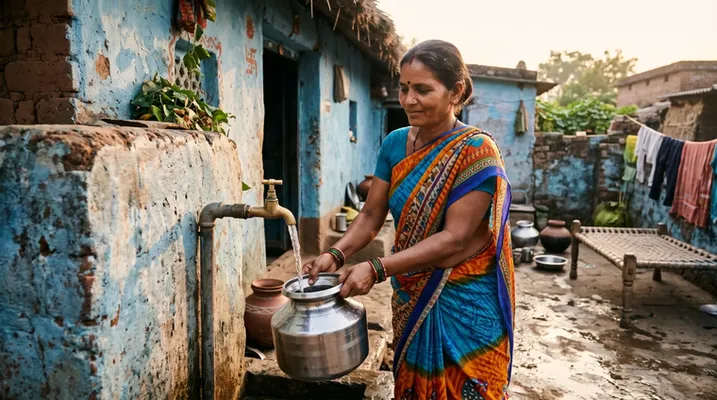
In August 2019, only about 17 percent of rural households in India, roughly 3.2 crore or 32 million homes, had a tap delivering water inside their compound. By early 2026, the government reported that about 15.8 crore homes, around 81.6 percent of rural households, had a functional tap connection. That is more than 120 million new household connections in under seven years, likely the largest plumbing rollout in human history. In March 2026, India’s cabinet extended the Jal Jeevan Mission to December 2028 with an enhanced outlay, restructuring it from building pipes to delivering reliable service. Here is the story, the debate about quality and sustainability, and why plumbers everywhere should pay attention.
By the Best Plumbers Editorial Team. Published November 22, 2026.
At Best Plumbers, we often say plumbing is the profession that protects the health of the nation, and we have argued that plumbers have saved more lives than doctors. India’s Jal Jeevan Mission is a living demonstration of that idea. When safe water arrives at the doorstep, children stop getting sick as often, girls stop missing school to fetch water and women regain hours of their day. A tap is not just a convenience. It is one of the most powerful public health tools ever invented.
What the Mission Set Out to Do
Launched by the central government in August 2019, the Jal Jeevan Mission, often called Har Ghar Jal, meaning water to every home, aimed to give every rural household a functional household tap connection providing safe and adequate drinking water. The original target was 2024. The scale was staggering: about 19.36 crore rural households, more than 190 million homes, across hundreds of thousands of villages with wildly different geography, from Himalayan hamlets to desert settlements to flood prone river plains.
The work involved finding and protecting water sources, building treatment plants and overhead tanks, laying pipelines through villages, connecting each household and training local people to run and maintain the systems. Water is a state subject in India, so state governments carried much of the implementation, with central funding and oversight.

Overhead tanks, pipelines and household connections have been built across hundreds of thousands of Indian villages since 2019.
The Results So Far
By early 2026, official figures showed about 15.8 crore rural households with tap connections, around 81.6 percent of the total, up from about 16.7 percent in August 2019. The government has cited estimates from the World Health Organization that universal coverage could prevent around 400,000 deaths from diarrheal disease and save some 5.5 crore hours of drudgery daily, mostly by women and girls who previously fetched water. A State Bank of India research report estimated the mission had freed about 9 crore women from fetching water. Other researchers have estimated potential reductions in under five child mortality.
These numbers come largely from government reporting and modeling, and independent verification is an important part of the debate, which we will get to. But the scale of change on the ground is visible in villages across the country.
Jal Jeevan Mission 2.0
In the February 2025 Union Budget, the finance minister announced the mission would be extended to 2028. In March 2026, the Union Cabinet approved a restructured mission with a total outlay of about 8.69 lakh crore rupees and central assistance of about 3.59 lakh crore rupees, up from 2.08 lakh crore approved in 2019 to 2020. The new phase, often called JJM 2.0, aims to connect all 19.36 crore rural households by December 2028 and certify every village council, or Gram Panchayat, as Har Ghar Jal.
Importantly, the restructuring shifts the focus from infrastructure creation to service delivery: making sure water actually flows, reliably and safely, every day. It introduces a national digital framework called Sujalam Bharat to map rural water systems from source to tap, assigns each village a unique service area identifier, requires local committees to take part in operations and promotes community maintenance events.
The Debate: Connections Versus Water
As with any program of this size, there are critics and concerns, and they deserve a fair hearing.
Functionality. Independent surveys and news investigations have found that some connections reported as complete do not deliver water regularly, deliver too little or deliver water of questionable quality. A tap with no water is not a success. The shift to service delivery in JJM 2.0 is partly a response to this concern.
Source sustainability. Many rural schemes rely on groundwater, and India is the world’s largest user of groundwater, with aquifers declining in many regions. Without recharge and conservation, new taps could run dry.
Water quality. Arsenic, fluoride, nitrates, salinity and bacterial contamination affect water in various regions. Treatment and testing are essential.
Operations and maintenance. Pipelines, pumps and valves need ongoing care and funding. Villages need trained operators, spare parts and the ability to collect fees.
Budget and timelines. Some analysts have questioned whether budget allocations match the stated ambitions and noted that the original 2024 deadline was missed.
Supporters respond that missing a hugely ambitious deadline while still connecting more than 120 million homes is a historic achievement, that problems are being addressed and that no country has ever attempted rural water access on this scale. Both views can be true at the same time.

Local plumbers and pump operators are essential to keeping village water systems running after construction ends.
What a Village Water Scheme Looks Like
For readers who have never seen one, a typical village scheme under the mission looks like this. Water is drawn from a borewell, a protected spring, a river intake or a larger regional pipeline fed by a reservoir. Where needed, it passes through treatment, ranging from simple chlorination to plants that remove iron, arsenic or fluoride. A pump lifts the water into an elevated storage tank, often a concrete tank on columns at the highest point in the village, so gravity can push water through the distribution network. From there, pipes, commonly HDPE or PVC, run along lanes to each house, ending in a metered or unmetered tap in the courtyard. Valves divide the village into zones, and an operator, usually a local person, runs the pump on a schedule, opens and closes valves, chlorinates the water and fixes leaks. Field test kits allow trained villagers, often women, to check water quality regularly. It is basic plumbing done at enormous scale, and when it works, it transforms daily life.
Why Maintenance Is the Real Test
Water professionals around the world know an uncomfortable truth: building water systems is easier than keeping them running. Across the developing world, studies over the decades have found large shares of hand pumps and small water systems out of service at any given time, usually because of a lack of spare parts, funding or trained people rather than any engineering flaw. India’s shift to service delivery recognizes this. Village water committees are being asked to collect modest user fees, manage repairs and monitor quality. Digital mapping aims to flag systems that stop delivering. Training local plumbers and operators means help is close at hand when a pump fails or a pipe bursts. Whether these measures succeed will decide whether the mission’s remarkable numbers translate into water that flows every day, year after year.
The Plumbers Behind the Pipes
Here is the part we care about most. A program like this needs an army of skilled people: pipe fitters, plumbers, pump operators, electricians, masons and water quality technicians. India has trained large numbers of local people, often including women, as plumbers and operators under skilling programs linked to the mission. Some studies have estimated that the mission generated millions of person years of employment during construction. Once systems are built, the long term need is for local maintenance skills, which is exactly the shift JJM 2.0 emphasizes.
We celebrated the growing role of women in the trade in women in plumbing, and India’s experience training women as village plumbers and water testers is one of the most inspiring examples anywhere. The plumbing profession is global, even if standards and practices differ from country to country, as we explored in is plumbing the same around the world.
A Story of Dignity
Numbers can obscure what this really means to a family. For generations, millions of women and girls in rural India began their days walking to a well, hand pump or pond, often several times a day, carrying heavy pots on their heads in heat, monsoon rain and darkness. That time and effort came at the cost of school, paid work, rest and safety. A tap in the courtyard returns those hours. It means a mother can bathe a sick child without a long trip, an elderly person can stay clean and a girl can stay in class. Reporters who have visited connected villages describe the change in simple, powerful terms. That is why, for all the debates about data and deadlines, this mission matters so much.
Lessons for the World
India’s mission matters far beyond its borders. Roughly two billion people worldwide still lack safely managed drinking water, a central theme of the UN Water Conference we previewed in the world meets in Abu Dhabi. The lessons from Jal Jeevan apply everywhere: political commitment and funding can move fast; counting connections is not the same as delivering water; sources must be protected; and systems last only as long as local people can maintain them. Cities with aging pipes, from Johannesburg to Mexico City, show what happens when maintenance falls behind construction.
Sanitation is the other half of the story. India’s earlier Swachh Bharat campaign built tens of millions of toilets, and the link between water supply and sanitation is essential for health. We honored the toilet’s life saving role in World Toilet Day 2026.
What This Means for Readers Elsewhere
For readers in wealthy countries, it is easy to take a tap for granted. India’s mission is a reminder of what a tap means. It also offers lessons for rural communities in North America, the UK, Australia and elsewhere where private wells and small systems face their own challenges with contamination, aging equipment and a shortage of trained operators. Testing your water, maintaining your system and using certified water filtration where needed are universal practices. And the global need for skilled people means plumbing remains one of the most portable and meaningful careers on Earth. Explore opportunities on our plumbing jobs page and connect with organizations through our plumbing associations directory.
Our Warning: Water Quality Still Matters
Whether in a village in Rajasthan or a farmhouse in Ohio, a working tap does not guarantee safe water. Contaminants like arsenic, fluoride, nitrates and bacteria can be present in water that looks perfectly clear. Regular testing by accredited laboratories, proper treatment and good maintenance are essential. Be cautious of anyone selling treatment equipment without testing first.
Our Optimistic Take
We are genuinely inspired by the Jal Jeevan Mission. Whatever its shortcomings, it has brought running water to tens of millions of families who never had it, and it has elevated the status of plumbing and water work in villages across India. The shift toward service quality and local ownership is exactly right. If the mission reaches its 2028 goal with water that flows reliably and safely, it will stand as one of the great public health achievements of the century.
How Best Plumbers Helps
Best Plumbers has been the Internet's original plumbing directory since July 12, 2002, serving readers around the world. We list every plumbing company and show every review, good and bad, and our Best Plumbers Recommended seal marks those we trust most. We never sell leads. Find trusted plumbers through our locations directory and read the reviews.
The Short Version
India’s Jal Jeevan Mission has expanded rural tap connections from about 17 percent of households in 2019 to about 81.6 percent in 2026, more than 120 million new connections. The mission was extended to December 2028 with an enhanced outlay of about 8.69 lakh crore rupees, shifting focus from building infrastructure to reliable service. Critics raise concerns about functionality, source sustainability, water quality and maintenance. Its lessons apply worldwide: connections must deliver safe water every day, and skilled local plumbers make it last.
Frequently Asked Questions About the Jal Jeevan Mission
1. What is the Jal Jeevan Mission?
India’s national program, launched in 2019, to give every rural household a functional tap water connection.
2. How many rural households had taps in 2019?
About 3.2 crore, roughly 17 percent.
3. How many have taps now?
About 15.8 crore, roughly 81.6 percent, according to early 2026 government figures.
4. How many households is the target?
About 19.36 crore rural households.
5. When is the new deadline?
December 2028.
6. What is JJM 2.0?
The restructured mission focused on reliable service delivery, governance and community ownership.
7. How much funding is involved?
A total outlay of about 8.69 lakh crore rupees, with about 3.59 lakh crore in central assistance.
8. What does Har Ghar Jal mean?
Water to every home.
9. What health benefits are expected?
WHO estimates cited by the government include preventing around 400,000 diarrheal deaths.
10. How does it help women?
It saves hours spent fetching water; one estimate says about 9 crore women were freed from the task.
11. What is Sujalam Bharat?
A national digital framework mapping rural water systems from source to tap.
12. Do all connections deliver water?
Critics have found some do not deliver reliably, which JJM 2.0 aims to address.
13. Is groundwater a concern?
Yes. Many schemes rely on declining aquifers that need recharge and protection.
14. What water quality problems exist?
Arsenic, fluoride, nitrates, salinity and bacteria in some regions.
15. Who maintains village systems?
Increasingly, trained local operators and village water committees.
16. Are women being trained as plumbers?
Yes. Skilling programs have trained many local people, including women, as plumbers and testers.
17. Is this the largest water program in the world?
It is widely described as one of the largest rural water supply programs ever undertaken.
18. How does this relate to global goals?
It supports UN Sustainable Development Goal 6 on clean water and sanitation.
19. Why was the 2024 deadline missed?
The scale, geography, source challenges and implementation issues slowed progress.
20. What about sanitation?
India’s Swachh Bharat campaign built tens of millions of toilets, complementing water supply.
21. Does a tap mean safe water?
Not necessarily. Testing and treatment are still essential.
22. Can plumbers work internationally?
Yes. Plumbing skills are needed worldwide, though licensing differs by country.
23. What can other countries learn?
Commitment can move fast, but service quality and maintenance decide long term success.
24. How do I find a trusted plumber?
Search Best Plumbers, read every review, look for the Best Plumbers Recommended seal and confirm credentials.
25. Why does Best Plumbers cover India’s water mission?
Since 2002, Best Plumbers has championed the plumbing profession’s role in protecting public health worldwide.
Sources
Prime Minister’s Office of India, Cabinet approves extension of Jal Jeevan Mission. Press Information Bureau, Ministry of Jal Shakti release. Down To Earth, goalpost for Jal Jeevan Mission moves to 2028. The Print, JJM 2.0 to focus on service delivery.

