

In Durban, South Africa’s third largest city, running water has become unreliable for a large share of households. According to Statistics South Africa’s 2025 General Household Survey, as reported by the news site GroundUp, 44 percent of households in the eThekwini metro, which includes Durban, experienced water outages lasting two days or more during the year, the highest share among the country’s eight major metros, compared with just 8 percent in Cape Town. In 2026, things got worse at times: a valve failure at the Nagle Dam aqueduct in March cut raw water supply to a major treatment works, some neighbourhoods went more than a week without water, and in July officials blamed sabotage and vandalism for outages affecting thousands. Here is what is happening, why and what cities and households everywhere can learn.
By the Best Plumbers Editorial Team. Published November 22, 2026.
Best Plumbers has readers across South Africa, and we have written before about the water crisis in Johannesburg, in the Johannesburg water crisis. Durban’s situation has its own causes, but the underlying problem is familiar: aging, poorly maintained pipes that leak and burst, systems without redundancy and communities paying the price.
What the Data Show
Most South African households now have piped water. In 2025, 76 percent had a tap inside their home or on their property, according to Stats SA. But reliability is another matter. More than a third of households nationally, about 38 percent, experienced water outages lasting two days or more during the year. The eight metros did slightly better than the national average, at 30 percent, but the range was enormous: Cape Town had the smallest share at 8 percent, while eThekwini had the largest at 44 percent. GroundUp’s analysis identified old, poorly maintained pipes that leak and burst as the main reason, noting that even in Cape Town, about a quarter of water is lost before it reaches taps, according to the national Department of Water and Sanitation.
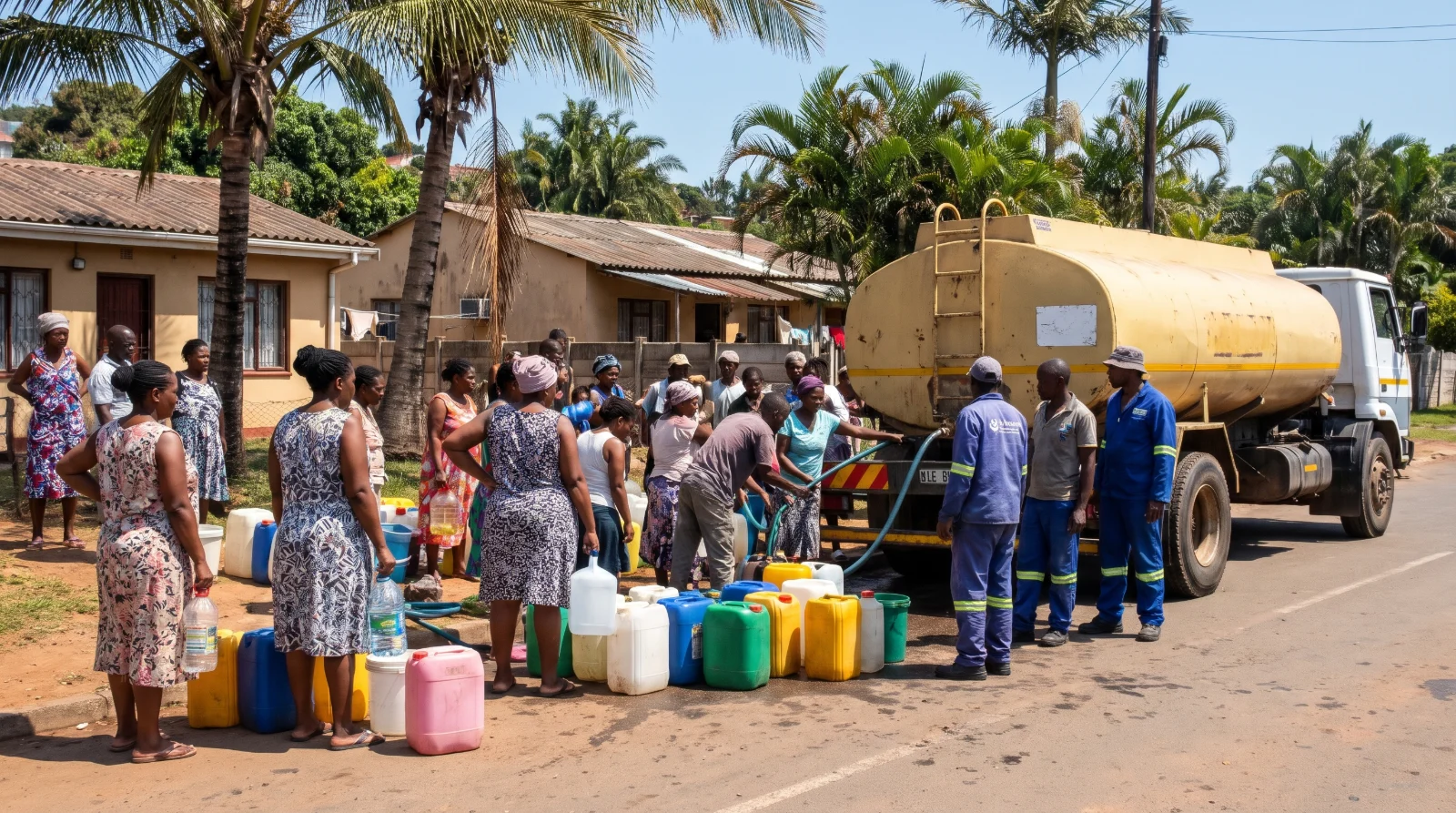
When taps run dry, many Durban residents rely on municipal water tankers to meet basic needs.
The 2026 Disruptions
In January and February 2026, residents in several areas reported extended outages. Residents of Springtown, north of Durban, reported going nine days without running water, relying on tankers supplied by the municipality while community leaders pleaded for intervention. A heatwave increased demand and strained supply from some treatment works.
On March 11, 2026, the bulk water supplier uMngeni uThukela Water reported damage to a control valve at the Nagle Dam aqueduct system feeding the Durban Heights Water Treatment Works, which supplies large parts of the metro. The fault created a supply deficit of about 150 megalitres a day. Repairs allowed full pumping to resume on March 16, but officials cautioned that reservoir levels across the system would take additional time to recover. In the meantime, residents were frustrated to see a major burst pipe in one suburb leak for more than 13 hours while the city urged conservation.
In July 2026, further aqueduct shutdowns were needed to assess and clear a possible blockage, and leaks on pipelines to the Pinetown area disrupted supply. Later that month, thousands of residents were left without water after what the municipality described as sabotage of water infrastructure, and the mayor appealed to residents to protect infrastructure and report vandalism. Councillors called for real time outage alerts so residents could get accurate information about repairs.
Why Durban’s System Struggles
Aging infrastructure. Much of the network is decades old and has suffered from insufficient maintenance and renewal. Pipes leak and burst, and every burst means an outage for someone.
Limited redundancy. When a single valve or aqueduct fails, large parts of the city can lose supply, as the March 2026 failure showed. Systems with backup routes and storage recover faster.
Water losses. Leaks and unbilled water reduce what reaches customers and the revenue needed to maintain the system.
Flood damage. Severe floods in KwaZulu Natal in recent years damaged pipelines, pump stations and treatment works.
Vandalism and theft. Damage to valves, pipes and pump stations, sometimes linked to disputes or criminal activity, causes outages and diverts resources.
Capacity and contractor issues. Local reports in 2026 noted tensions with plumbing contractors working for the municipality, including talk of a strike, and questions about repair turnaround times.
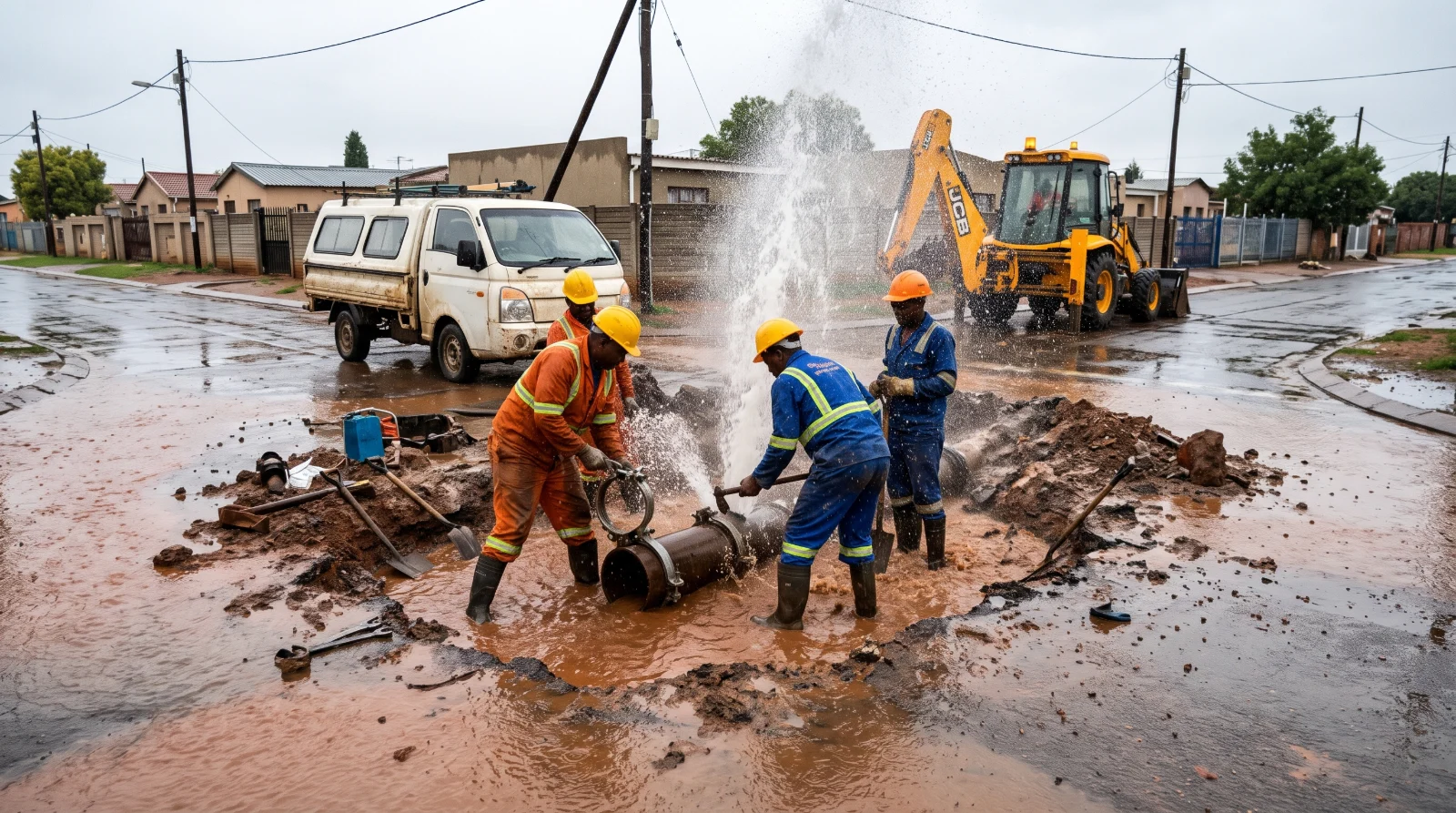
Burst pipes are the most common cause of outages in South African cities, according to analysis of national survey data.
How Outages Damage Home Plumbing
Repeated outages do more than inconvenience households. They can damage plumbing. When supply stops and restarts, air enters the pipes. When water returns, trapped air can cause sputtering taps and water hammer, the banging sound of pressure waves in pipes, which stresses joints and fittings. Sediment and rust dislodged from mains can clog aerators, shower heads, valves and appliance filters. Pressure surges when supply is restored can burst weak pipes and flexible connectors. In South African homes, one of the most common and costly problems involves the geyser, the local term for an electric hot water cylinder. If a geyser drains or loses supply while its element is still powered, the element can overheat and burn out, and valves can be damaged. During extended outages, many plumbers advise switching off the geyser at the distribution board until water is restored and the cylinder is full again. Installing a pressure reducing valve and proper vacuum breakers helps protect the system, and a plumber can check the geyser’s safety valves after repeated outages.
How a Backup Tank System Works
Many Durban homes and businesses now install backup water systems. A typical setup includes a polyethylene tank on a level base, filled from the municipal supply through a float valve, with a pump and pressure vessel that feed water into the house when mains pressure drops. Some systems switch automatically; others use manual valves. Good installations include a non return valve or backflow device so tank water cannot flow back into the municipal network, a filter on the outlet, overflow protection and a way to bypass the system for maintenance. Tanks should be kept covered to prevent mosquitoes and contamination and cleaned periodically. For drinking water, many households add point of use filtration. A properly designed system lets a household ride out a short outage with little disruption, while a poorly designed one can contaminate supply or fail when it is needed most. This is work for a registered plumber.
The Debate
As in Johannesburg, opinions differ on causes and cures. Many residents and opposition councillors blame years of underinvestment, poor maintenance, procurement problems and slow repairs. Municipal and bulk water officials point to aging infrastructure inherited over decades, flood damage, rapid growth, vandalism and the sheer scale of the repair backlog, while highlighting progress on specific projects. Analysts suggest that sustainable fixes require ring fenced funding for maintenance, stronger technical capacity, better data and accountability, and partnerships with the private sector and communities. All sides agree that residents deserve reliable water and better communication.
Why Reducing Water Losses Matters So Much
In many South African municipalities, a large share of treated water never generates revenue, lost to leaks, bursts, illegal connections and metering errors. Water professionals call this non revenue water. High losses create a vicious circle: lost water means lost revenue, lost revenue means less money for maintenance, and less maintenance means more leaks. Breaking the cycle requires active leak detection, faster repairs, pressure management, replacement of the worst pipes and better metering. Cities that have invested consistently in loss reduction, such as Cape Town during and after its own drought crisis, have shown that progress is possible. It is not glamorous work, but it is the foundation of reliable supply.
Lessons for Cities Everywhere
Durban’s experience parallels challenges in cities around the world. Mexico City loses roughly 40 percent of its water to leaks. Wellington restructured its water services after years of failures, as we described in goodbye Wellington Water, hello Tiaki Wai. Asheville learned the cost of having no redundancy, as we covered in two years after Helene. And world leaders will discuss these exact issues at the UN Water Conference, which we previewed in the world meets in Abu Dhabi.
The common lessons are clear: maintain what you have, build redundancy, measure and reduce losses, communicate openly with residents and invest in the skilled people who run the system. The pipes beneath our streets, which we described in the hidden grid beneath your street, are only as reliable as the care they receive.
What Durban Households Can Do
Store water safely. Many households now keep JoJo style tanks or containers. Keep storage clean and covered, and use food grade containers for drinking water.
Install a backup tank properly. Rooftop or ground tanks with pumps and pressure systems can keep a home supplied during outages. Have a qualified plumber install them with correct valves to prevent contamination of the municipal supply.
Treat water when needed. After outages, water may be cloudy or discoloured as pipes refill. Let taps run until clear, and use boiling or certified water filtration for drinking water when quality is uncertain.
Fix leaks on your property. Every litre lost on private property adds to the burden. Watch your meter and use professional leak detection when needed.
Report bursts and vandalism. Report leaks and suspicious activity to the municipality promptly.
Businesses, Schools and Clinics
Outages hit businesses, schools and health facilities especially hard. Restaurants cannot cook or clean, schools may send learners home and clinics must find alternative supplies for hygiene and treatment. Many Durban businesses have invested in large storage tanks and booster pumps, and some schools have installed rainwater harvesting systems with community support. For any facility, a water continuity plan should identify how much water is needed per day, how long storage will last, who refills it, how water quality is protected and how staff will be informed. A registered plumber can size storage and pumps and make sure the installation meets regulations. These investments cost money, but they keep doors open and protect public health when the taps run dry.
Our Optimistic Take
For all its challenges, South Africa has made enormous progress in extending piped water to households over the past three decades, and many dedicated engineers, plumbers and officials are working hard to improve reliability. Cape Town’s comparatively strong performance shows what consistent investment and management can achieve. With focused maintenance, accountability and community cooperation, Durban’s taps can become reliable again.
A Salute to South Africa’s Plumbers
South Africa’s plumbers and water workers do difficult work under difficult conditions, often fixing bursts in the middle of the night, facing frustrated communities and sometimes working without the materials or support they need. Their skills are in high demand across the country, from municipal repair teams to private contractors installing tanks and pumps. For young South Africans, plumbing offers a valuable trade with real social impact. Practices vary by country, as we discussed in is plumbing the same around the world, but the need for skilled hands is universal. Explore opportunities on our plumbing jobs page.
Our Warning: Water Crisis Scams
Water shortages attract unlicensed operators, overpriced tank installations, illegal connections and fake officials. Use registered plumbers, verify anyone claiming to work for the municipality and be wary of water vendors whose sources and quality you cannot confirm.
How Best Plumbers Helps
Best Plumbers has been the Internet's original plumbing directory since July 12, 2002, serving readers in South Africa and around the world. We list every plumbing company and show every review, good and bad, and our Best Plumbers Recommended seal marks those we trust most. We never sell leads. Find registered plumbers through our locations directory and read the reviews.
The Short Version
Stats SA data reported by GroundUp show 44 percent of eThekwini households had water outages of two days or more in 2025, the highest among South Africa’s metros, compared with 8 percent in Cape Town. In 2026, a Nagle Dam valve failure cut supply by about 150 megalitres a day, some areas went over a week without water and officials blamed vandalism for further outages. Aging pipes, limited redundancy, flood damage and maintenance backlogs are key causes. Households can store water safely, install backup tanks properly, fix leaks and report problems.
Frequently Asked Questions About Durban’s Water Outages
1. How common are long water outages in eThekwini?
About 44 percent of households reported outages of two days or more in 2025.
2. How does that compare with Cape Town?
Cape Town had the lowest share among metros, at 8 percent.
3. What is the national figure?
About 38 percent of South African households had long outages in 2025.
4. What happened at Nagle Dam in 2026?
A control valve failure cut raw water to Durban Heights, creating a deficit of about 150 megalitres a day.
5. When was full pumping restored?
On March 16, 2026, though reservoirs took longer to recover.
6. Did some areas go without water for days?
Yes. Springtown residents reported nine days without water in early 2026.
7. Was vandalism involved?
The municipality attributed some July 2026 outages to sabotage and vandalism.
8. What is the main cause of outages?
Old, poorly maintained pipes that leak and burst.
9. What is Durban Heights?
A major water treatment works supplying large parts of eThekwini.
10. Who supplies bulk water to Durban?
uMngeni uThukela Water.
11. How many South Africans have piped water?
About 76 percent of households had a tap at home or on their property in 2025.
12. How much water does Cape Town lose?
About a quarter, according to national figures.
13. Should I install a water tank?
Many households do; have a qualified plumber install it correctly.
14. Can backup tanks contaminate municipal water?
Improper connections can; proper valves prevent backflow.
15. Is water safe after an outage?
Run taps until clear and treat drinking water if quality is uncertain.
16. How do I report a leak in Durban?
Through the municipality’s official channels and app.
17. Did floods damage the system?
Yes. Recent KwaZulu Natal floods damaged water infrastructure.
18. Are outage alerts planned?
Councillors have called for real time outage alerts.
19. What can cities learn?
Maintain pipes, build redundancy, reduce losses and communicate openly.
20. Are plumbers in demand in South Africa?
Yes, for municipal repairs, tank installations and private work.
21. How do I avoid water scams?
Use registered plumbers and verify officials.
22. Is Johannesburg facing similar problems?
Yes, Johannesburg also experiences frequent long outages.
23. What is redundancy in water systems?
Backup routes and storage so one failure does not cut supply.
24. How do I find a trusted plumber?
Search Best Plumbers, read every review, look for the Best Plumbers Recommended seal and confirm registration.
25. Why does Best Plumbers cover Durban?
Since 2002, Best Plumbers has served readers in South Africa and worldwide.
Sources
GroundUp via AllAfrica, Durban and Joburg worst hit by water outages. uMngeni uThukela Water, full pumping restored to Durban Heights. IOL, mayor urges community to safeguard infrastructure and residents left dry for nine days.

