
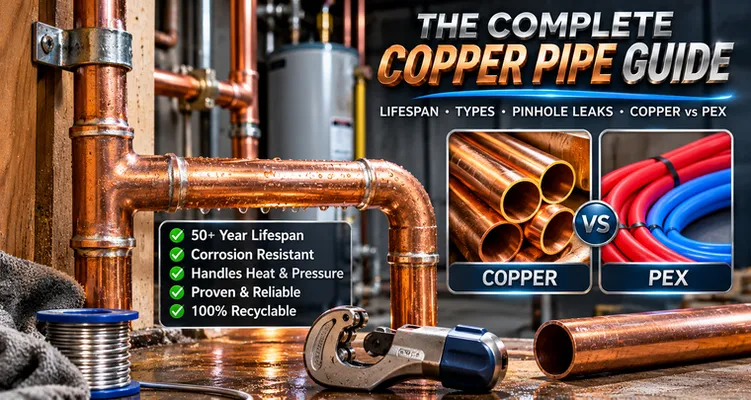
Copper pipe is the most proven water supply material in plumbing. Properly installed copper typically lasts 50 years or more, resists corrosion, holds up to heat and pressure, and is 100% recyclable. It comes in three common wall thicknesses (Type K, L and M), and its main weaknesses are cost and pinhole leaks caused by aggressive water chemistry or high water velocity. Below, our plumbing editors explain everything a homeowner needs to know, inspired by HISTORY's Modern Marvels episode on copper.
By the Best Plumbers Editorial Team. Published November 16, 2026.
Few materials have shaped the modern world like copper. It carries the electricity that lights your home, the heat in your air conditioner and, almost certainly, at least some of the water you drink. In the HISTORY Channel episode Modern Marvels: How Copper Built the World, the narrator calls it the metal that ended the Stone Age and ushered in the Information Age. For plumbers, it is something simpler: the pipe we trust.
The full episode runs about 44 minutes and visits shipyards, open-pit mines, refineries, bell foundries and chip factories. It is well worth watching. Then read on for what it means for the pipes inside your walls.
Key Takeaways
- Lifespan: Copper water pipe commonly lasts 50 years or more, but water chemistry, flow velocity and workmanship decide the real number.
- Types: Type K (green stripe) is the thickest, Type L (blue) is the common professional standard, and Type M (red) is the thinnest.
- Leaks: Most copper failures are pinhole leaks from internal pitting or erosion corrosion, not old age alone.
- Safety: Copper is safe for drinking water. Homes plumbed before 1986 may have lead-based solder at the joints.
- Copper vs PEX: Copper wins on durability, heat tolerance and recyclability. PEX wins on cost, speed and freeze tolerance.
What the Modern Marvels Episode Gets Right About Copper
The episode opens at the NASSCO shipyard in San Diego, where builders explain that copper goes into nearly every part of a ship that touches seawater. Copper nickel pipe, typically 70% copper and 30% nickel, carries seawater because a thin protective oxide layer forms on the inside of the pipe and stops further corrosion. That same self-protecting behavior is exactly why copper works so well in your home's water lines.
From there, the show traces copper back nearly 10,000 years. Copper is one of the few metals found in pure metallic form in nature, which is why it was among the first metals people ever worked. Later civilizations learned to smelt it from ore, then mixed in tin to make bronze, launching the Bronze Age. The episode also tells the story of Paul Revere, who supplied copper bolts and fittings for the USS Constitution and later built one of America's first copper rolling mills to sheath her hull.
Then comes the part plumbers love. The show explains that the plumbing industry is one of the biggest users of recycled copper, and that plumbers choose copper pipe because it is naturally corrosion resistant and frequently outlasts the building it is installed in. A copper industry expert compares making copper tube to squeezing toothpaste: a heated billet of copper is forced through an extrusion press around a mandrel, and seamless tube comes out the other end. He even jokes that the copper tube in your house could contain recycled metal from jewelry Cleopatra wore.
The episode also notes that ancient Egyptians produced some of the earliest copper plumbing, and that they may have been purifying their water without realizing it, thanks to copper's antimicrobial properties. We cover the long story of plumbing metals in From Plumbum to Pb: How Lead Gave Plumbers Their Name, and why copper eventually replaced lead as the plumber's metal of choice.
How Copper Pipe Is Made
The journey from mountain to faucet is remarkable. According to the episode, a typical Arizona copper mine yields only about six pounds of copper from every ton of ore. The ore is crushed, ground into slurry and separated by flotation, then smelted into copper that is about 99.6% pure. That is not pure enough, so it goes through electrorefining, which produces cathodes that are 99.99% pure copper.
In North America, copper water tube is manufactured to ASTM B88, the standard for seamless copper water tube in three basic wall thicknesses. Every length is stamped with its type and manufacturer at regular intervals, so a plumber can identify exactly what is in your walls. You can review the official color codes and applications in the Copper Development Association's copper tube types and color code table.
Type K vs Type L vs Type M Copper Pipe
All three types share the same outside diameter for a given nominal size, so they use the same fittings. What changes is the wall thickness, which affects pressure rating, durability and price.
| Type | Color stripe | Wall (1/2 inch) | Typical use |
|---|---|---|---|
| Type K | Green | 0.049 inch | Underground water services, direct burial, heavy duty |
| Type L | Blue | 0.040 inch | Interior water distribution, commercial work, most repipes |
| Type M | Red | 0.028 inch | Residential water lines where local code allows |
| DWV | Yellow | Thin | Drain, waste and vent lines (non-pressure) |
A common myth is that red-striped pipe is for hot water and blue is for cold. The color only identifies the wall thickness. Many experienced plumbers prefer Type L for interior water lines because the thicker wall gives more margin against erosion and pinholes, and the Uniform Plumbing Code requires Type L rather than Type M for water piping run underground within a building, such as in a slab. For a deeper look at sizing and flow, see our complete plumbing pipe size chart guide.
How Long Does Copper Pipe Last?
Industry sources commonly cite a service life of 50 years or more for copper water pipe, and we regularly see copper from the 1950s and 1960s still working perfectly. But that number is an estimate, not a guarantee. Two houses on the same street can age very differently.
Four factors decide how long your copper will last:
- Water chemistry. pH, hardness, dissolved solids and disinfectants such as chloramine all affect how quickly the protective layer inside the pipe forms and holds.
- Water velocity. Undersized pipe, oversized recirculation pumps and sharp fittings create turbulence that literally wears copper away from the inside.
- Wall thickness. Type L has more metal to lose than Type M before a hole forms.
- Workmanship. Excess flux left inside joints, poorly reamed pipe ends and bad grounding can all start corrosion early.
If your water is hard or unusually soft, it is worth understanding how it affects your pipes. Our guide on How Hard Water Affects Your Plumbing (and What You Can Do About It) explains what to test for.
Why Copper Pipes Get Pinhole Leaks
Pinhole leaks are the most common way copper pipe fails, and they almost always start on the inside. The main culprits are:
- Pitting corrosion. Localized corrosion eats a tiny, deep pit through the wall. It is linked to certain water chemistries, including some hard, high-dissolved-solids water and some very soft, high-pH water.
- Erosion corrosion. Fast, turbulent water scours away the protective layer, often right after elbows, tees and pumps. The pits usually have a horseshoe shape pointing downstream.
- Disinfectant chemistry. Chloramine and other treatment changes have been associated with accelerated corrosion in some areas.
- Installation problems. Leftover flux, burrs and improper electrical bonding can all concentrate corrosion.
Warning signs include blue-green stains on fixtures or around fittings, small damp spots on drywall or ceilings, a hissing sound in a wall, and a water meter that moves when every fixture is off. One pinhole is often a warning that others are coming. A good plumber will look for the root cause, not just clamp the leak. If you are weighing spot repairs against a lining system or a repipe, compare your options in Traditional Pipe Repair vs. Picote Brush Coating: Which Pipe Fix Is Right for Your Home?.
Is Copper Pipe Safe for Drinking Water?
Yes. Copper has been used for drinking water for generations, and it is an essential nutrient in small amounts. The US EPA's Lead and Copper Rule sets an action level of 1.3 milligrams per liter for copper at the tap. New copper can release slightly more copper for a short time until its protective layer forms, and very aggressive water can raise levels, which is another reason to know your water chemistry.
The episode highlights copper's famous antimicrobial power, and the science backs it up. In 2008 the EPA registered antimicrobial copper alloys with public health claims, and testing showed copper alloy surfaces killing more than 99.9% of MRSA bacteria within two hours at room temperature. You can read the Copper Development Association announcement. That registration applies to touch surfaces, though. Copper pipe is not a substitute for proper water treatment, and biofilm can still form inside any plumbing system.
The real safety concern in older copper systems is not the copper. It is the solder. In 1986, Congress amended the Safe Drinking Water Act to require lead-free pipe, solder and flux in plumbing for drinking water. Homes plumbed before then may have lead-based solder at the joints. If your home is older, have your water tested and ask a plumber about your service line, too. Learn more in EPA's $2.9 Billion Lead Pipe Push: What It Means for Your Home's Water.
Copper vs PEX vs CPVC: Which Is Best?
There is no single best pipe for every home. Here is how the three most common water supply materials compare:
| Factor | Copper | PEX | CPVC |
|---|---|---|---|
| Track record | Generations of proven use | Widely used since the 1980s and 1990s | Decades of use, mostly in warm climates |
| Material cost | Highest | Lowest | Low |
| Installation speed | Slower, requires soldering or press tools | Fastest, flexible runs | Moderate, solvent welded |
| Heat and UV | Excellent | Must be kept out of sunlight | Can become brittle with age |
| Freeze tolerance | Can split when frozen | Expands, more forgiving | Can crack when frozen |
| Recyclable | 100% | Limited | Limited |
Copper remains our first choice for exposed runs, mechanical rooms, water heater connections and any place where heat, fire resistance or longevity matter most. PEX often makes sense for whole-house repipes in occupied homes because it needs fewer wall openings. Many of the best plumbers use both. For more on plastic options, read CPVC vs. PVC: What’s the Difference?, and see how one city's code debate played out in Omaha Approves More PVC Pipe: What the Plumbing Code Change Means.
What Copper Pipe Costs in 2026
Copper is a globally traded commodity, so its price moves with world markets, mining output, electrification demand and trade policy. When copper rises, so do quotes for repipes, water heater installs and even simple repairs. We break down the forces behind recent price swings in Copper Prices and Tariffs in 2026: Why Your Plumbing Quote Changed. And remember that labor and expertise are a large part of any quote, as we explain in The $550, 30-Minute Repair: What You Really Pay For When You Hire a Pro.
The upside of copper's value is recycling. As the episode points out, copper is 100% recyclable, and a large share of the copper in use today has been used before. Old copper removed during a repipe has real scrap value, so ask your plumber how it will be handled.
How to Make Your Copper Pipes Last Longer
- Keep water pressure in check. Most plumbing codes call for a pressure reducing valve when street pressure exceeds 80 psi. High pressure strains joints and speeds erosion.
- Test your water. Know your pH, hardness and disinfectant type, especially on a private well.
- Isolate dissimilar metals. Where copper meets galvanized steel, a proper dielectric union or fitting prevents galvanic corrosion.
- Protect pipes from freezing. Insulate pipes in crawl spaces, garages and exterior walls. Our master plumber’s fall checklist walks you through it.
- Fix the first pinhole properly. Have a plumber inspect the removed section to find the cause before more leaks appear.
- Know your system. Understanding how plumbing works in a house helps you spot trouble early.
Should You Repair or Replace Your Copper Pipes?
A single leak on a sound system is usually a simple repair. Consider a repipe when you have had several pinhole leaks within a year or two, when leaks show up in different parts of the house, when you see widespread green corrosion on the outside of pipes, or when your home has a mix of copper and old galvanized steel. A licensed plumber can cut out a section and examine the inside wall to judge how much life is left. If you love the look and performance of copper and want to keep it, our article on The Beauty of Copper Plumbing: A Timeless Choice explains why so many homeowners stay with it.
Curious about the companies that make the pipe, valves and fittings in your home? Browse the brands and manufacturers in our plumbing products directory.
Frequently Asked Questions About Copper Pipe
1. How long does copper pipe last?
Copper water pipe commonly lasts 50 years or more, and many systems from the mid-1900s are still in service. Actual life depends on water chemistry, water velocity, wall thickness and installation quality, so two homes can age very differently.
2. What is the difference between Type K, Type L and Type M copper pipe?
The difference is wall thickness. Type K (green) is the thickest and is used underground. Type L (blue) is a medium wall used for most interior and commercial water lines. Type M (red) is the thinnest and is used in homes where code allows. All share the same outside diameter.
3. Is copper pipe safe for drinking water?
Yes. Copper is safe for drinking water and is regulated by the EPA, which sets an action level of 1.3 mg/L for copper at the tap. In homes plumbed before 1986, the bigger concern is lead-based solder at the joints, so older homes should have their water tested.
4. What causes pinhole leaks in copper pipes?
Pinhole leaks are usually caused by internal pitting corrosion or erosion corrosion. Aggressive water chemistry, high water velocity, excess soldering flux and poor electrical bonding are the most common triggers. Several pinholes in a short time often signal a system-wide problem.
5. Is copper better than PEX?
Copper is more durable, handles heat and sunlight better, resists fire and is fully recyclable. PEX costs less, installs faster and tolerates freezing better. Copper is usually best for exposed, high-heat and long-life applications, while PEX is often the practical choice for whole-house repipes.
6. Why do copper pipes turn green?
The green or blue-green color is patina, a layer of copper corrosion products that forms when copper is exposed to moisture and air. On roofs it is decorative, but green crust on a water pipe or blue-green stains on fixtures can point to a slow leak or corrosive water.
7. Does copper pipe kill bacteria in water?
Copper surfaces are naturally antimicrobial, and the EPA has registered copper alloys as able to kill more than 99.9% of certain bacteria within two hours. Inside pipes, the effect depends on water chemistry and biofilm, so copper pipe is not a replacement for proper water treatment.
8. Can old copper pipes contain lead?
The copper itself does not, but joints in homes plumbed before the 1986 Safe Drinking Water Act amendments may have been made with lead-based solder. Some older brass fittings also contained lead. A water test and a plumber's inspection will tell you if lead is a concern.
9. Is old copper pipe worth money?
Yes. Copper is 100% recyclable and holds scrap value, which rises and falls with global copper prices. When you repipe, ask your plumber whether the removed copper will be recycled and whether that value is reflected in your quote.
10. When should I replace my copper pipes?
Consider replacement if you have had multiple pinhole leaks within a year or two, leaks in different areas of the home, heavy external corrosion, very low water pressure from internal buildup, or a mix of copper and aging galvanized steel. A licensed plumber can inspect a pipe section to confirm.
Find a Plumber Who Knows Copper
Working with copper is a true craft. Sweating a joint that stays tight for 50 years takes training, patience and the right tools, and so does diagnosing why a pinhole appeared in the first place. Best Plumbers has helped people find trusted plumbing professionals since 2002, and we publish every review, good and bad. Learn how to choose well in Plumbers Near Me: Find the Right Local Plumber Without the Runaround, then start your search for plumbers near me on the Internet's original plumbing directory.
Video credit: "Modern Marvels: How Copper Built the World (S13, E37)" by HISTORY on YouTube, published March 27, 2021, runtime 43:44.

