
The rules on PFAS, the so called forever chemicals, in American drinking water are in flux. In May 2026, the U.S. Environmental Protection Agency proposed keeping the national limits for PFOA and PFOS while allowing water systems that request it until April 2031 to comply, two years later than the current 2029 deadline, and separately proposed rescinding the limits on four other PFAS. Public comments closed in July, and final decisions are expected. Whatever happens in Washington, homeowners who are concerned can take practical, proven steps today, starting with knowing what is in their water and choosing a properly certified filter.
By the Best Plumbers Editorial Team. Published November 22, 2026.
We have been writing about water quality since Best Plumbers launched in 2002, and few topics generate as many reader questions as PFAS. People want to know whether their tap water is safe, whether bottled water is better, whether a pitcher filter does anything and what the new rules mean. We do not take sides in the policy debate. Our job is to explain it fairly and help you protect your household with solid information and good plumbing.
What Are PFAS?
PFAS, short for per and polyfluoroalkyl substances, are a large family of human made chemicals used for decades in products like nonstick cookware, stain resistant fabrics, food packaging and certain firefighting foams. They are called forever chemicals because their chemical bonds are extremely strong, so they break down very slowly in the environment and can accumulate in people and wildlife. They have been detected in water supplies in many countries. Health agencies have linked exposure to some PFAS with a range of health concerns, which is why regulators have moved to limit them in drinking water.
How the Rules Got Here
In April 2024, the EPA finalized the first national drinking water standards for PFAS. The rule set enforceable limits for six PFAS: PFOA and PFOS at 4 parts per trillion each, and PFHxS, PFNA and HFPO-DA, often called GenX, along with a hazard index for certain mixtures. Water systems were required to complete initial monitoring and begin compliance monitoring by April 2027, and to meet the limits by April 2029. Water utilities and industry groups challenged the rule in federal court.
On May 18, 2026, the EPA announced two proposals. The first would uphold the limits for PFOA and PFOS while letting systems that request additional time and meet criteria take until April 26, 2031 to comply. The second would rescind the standards for PFHxS, PFNA, HFPO-DA and the hazard index mixture, with the agency saying it would evaluate additional PFAS for future regulation. The EPA held a public hearing on July 7, and comments closed on July 20, 2026. Separately, the agency's draft list of contaminants that may need future regulation, published in April, includes PFAS.

Measuring PFAS at parts per trillion requires specialized laboratories. Utilities test source and treated water under the federal rules.
The Debate, Fairly Stated
Supporters of the proposals argue that many utilities, especially small ones, need more time to design, fund and build treatment systems, and that focusing on PFOA and PFOS targets the most studied compounds with a legally defensible approach. Some water officials said the extra time would help, while noting that parts of the proposal could be hard to implement. The agency has also pointed to growing markets for treatment technology driving costs down.
Critics of the proposals, including environmental and public health groups, argue that delaying compliance and dropping limits on four PFAS weakens protections communities were promised, leaves families exposed longer and creates uncertainty for utilities that have already started investing. Some technical reviewers submitted detailed comments challenging the basis for the extension.
Courts, final rulemaking and future administrations may all shape where this ends up. For homeowners, the practical message does not change: learn about your water and choose protection that matches your situation.
How to Find Out What Is in Your Water
If you are on public water, start with your utility. Many utilities publish PFAS monitoring results, and annual water quality reports, often called consumer confidence reports in the United States, list detected contaminants. Ask your utility directly whether PFAS have been detected and at what levels.
If you have a private well, you are responsible for testing. PFAS testing requires a laboratory that uses appropriate methods for PFAS at very low concentrations. Your state or local health department can often recommend certified labs. Wells near airports, military bases, industrial sites, landfills or places where firefighting foam was used deserve particular attention.
Be cautious about free in home tests. PFAS cannot be measured with a simple color strip. If someone offers to test for PFAS on your kitchen counter in a few minutes and then pitches an expensive system, be skeptical.
Filters That Actually Reduce PFAS
Not all filters are equal. The most important step is to choose a product that has been independently certified to reduce PFOA and PFOS, and ideally other PFAS, under recognized NSF and ANSI standards such as 53 or 58. Certification means the product was tested to verify its claims. Look for the specific contaminant claims on the certification listing, not just a general certification mark.
Reverse osmosis systems. Under sink reverse osmosis systems are among the most effective household options for reducing many PFAS at the kitchen tap. They push water through a very fine membrane and typically include carbon prefilters and a storage tank with a dedicated faucet. They produce some wastewater and need filter changes on schedule.
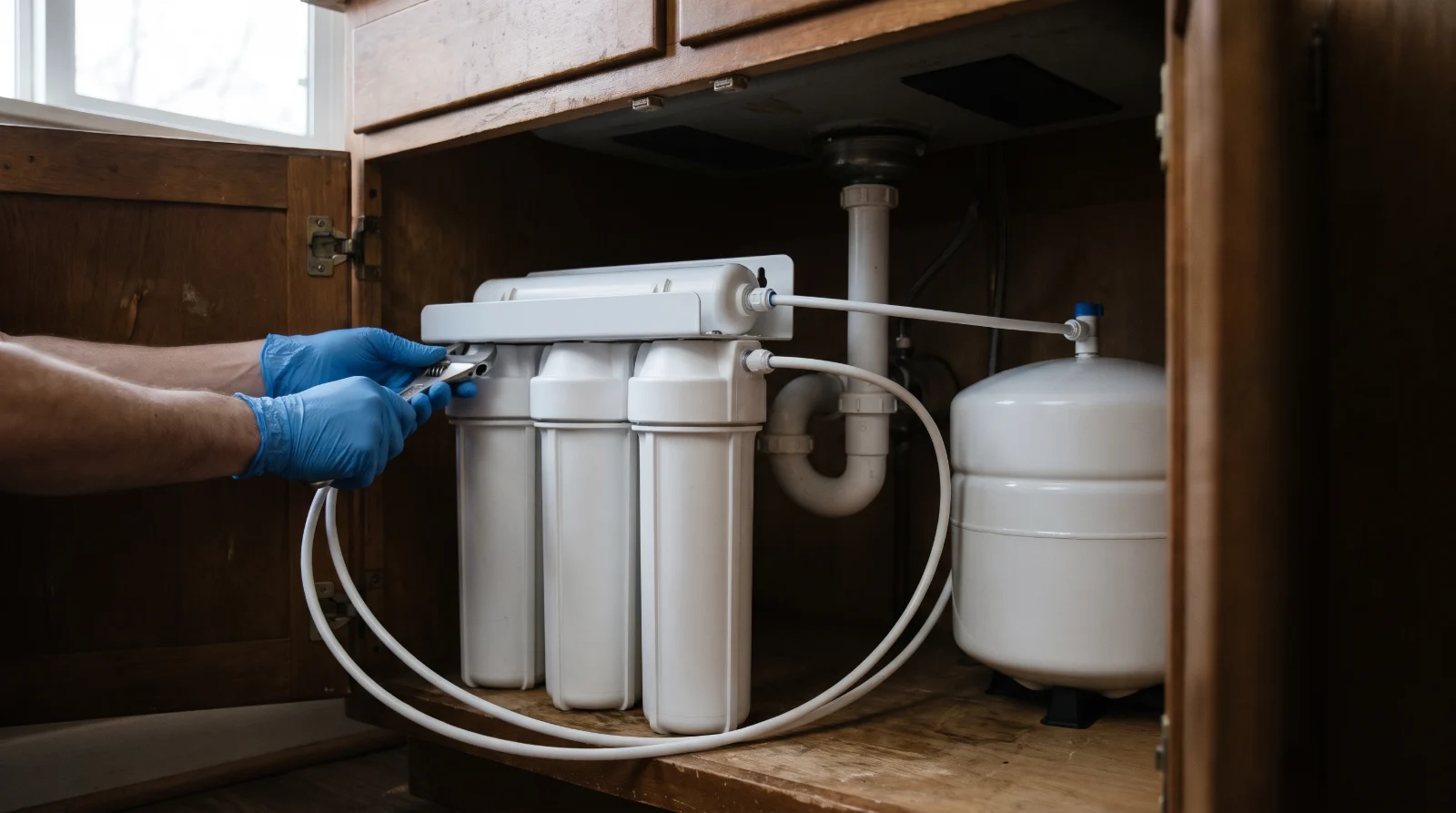
Under sink filtration, installed correctly and maintained on schedule, is one of the most practical ways to reduce PFAS at the tap.
Activated carbon filters. Some certified carbon filters, including certain pitcher, faucet mount, under sink and whole house units, can reduce PFOA and PFOS. Performance depends heavily on the specific product and on changing cartridges on time, because saturated carbon stops working.
Whole house systems. Point of entry carbon systems can treat all water entering the home, but they are larger investments. Many experts focus PFAS protection on drinking and cooking water, where exposure from ingestion matters most.
Boiling does not help. Boiling water does not remove PFAS and can concentrate them slightly as water evaporates.
A licensed plumber can recommend and install the right system for your home, make sure it is connected properly with backflow protection where needed, and set up a maintenance schedule. Start with our water filtration installation listings, and browse plumbing products to learn about the options.
Do Not Forget the Rest of Your Water Quality
PFAS get the headlines, but they are not the only concern. Lead from old service lines and plumbing remains a major issue in many older homes, as we covered in our report on lead pipe replacement and the 2027 deadline and in our newsroom piece on how lead service line replacement is accelerating. Hard water can damage fixtures and appliances, which we explain in what hard water really costs. A water softener does not remove PFAS, but it can protect your plumbing, and our water softener pros can help. The right solution often combines several pieces, so a professional assessment is worthwhile. Our plumbing inspection listings can get you started.
PFAS Around the World
PFAS are a global issue, and our readers from the UK to Australia ask about them often. The European Union's revised Drinking Water Directive introduced PFAS limits that member states must meet from 2026. Canada has set an objective for total PFAS in drinking water, and Australia updated its drinking water guidelines for several PFAS. Approaches differ, but the trend everywhere is toward more testing and more treatment. We explore how water and plumbing standards differ internationally in is plumbing the same around the world.
Warning: PFAS Scare Sales
Anxiety sells, and PFAS has become a favorite topic for aggressive water treatment salespeople. Watch for these red flags:
Instant tests. No legitimate in home test can measure PFAS in minutes.
Uncertified claims. If a product claims to remove PFAS but has no independent certification for those specific contaminants, be wary.
Pressure to buy today. Discounts that expire in an hour are a sales tactic, not a safety measure.
Oversized systems. Someone selling a very expensive whole house system when a certified under sink unit would meet your goals deserves a second opinion.
Long contracts and financing traps. Read every term before signing up for rentals or financing.
Get written quotes from licensed professionals and compare them using our plumbing cost guide. Read why it matters to hire properly licensed pros in the importance of hiring a licensed plumber.
Maintenance Is Where Most Filters Fail
We cannot stress this enough. A filter that is not maintained can be worse than no filter, because it gives a false sense of security. Mark cartridge change dates on a calendar or set phone reminders. Replace reverse osmosis membranes and prefilters on schedule. Sanitize systems as the manufacturer recommends. If you are unsure, ask your plumber to set up a maintenance plan.
Good News for Water Professionals
There is real optimism in this story. Treatment technology is improving and costs are coming down. Utilities are building new treatment plants and creating skilled jobs. Plumbers, water treatment specialists and laboratory professionals are all part of the solution. When families ask how to protect their water, it is often a local plumber who installs the system that gives them peace of mind.
How Best Plumbers Helps
Best Plumbers has been the Internet's original plumbing directory since July 12, 2002. We list every plumbing company and show every review, good and bad, and our Best Plumbers Recommended seal marks companies we trust most. We never sell leads. To find a pro who installs certified water treatment honestly, search plumbers near me and read the reviews.
The Bottom Line
The federal PFAS rules are being reconsidered, with proposals to extend deadlines for PFOA and PFOS to 2031 for some systems and to drop limits on four other PFAS. People disagree strongly about those changes, and the final outcome is still being decided. In the meantime, you can learn what is in your water, choose independently certified filtration if you are concerned, maintain it faithfully and avoid scare driven sales. That is practical protection that does not depend on Washington.
Frequently Asked Questions About PFAS in Drinking Water
1. What are PFAS?
PFAS are a large family of human made chemicals used in products like nonstick coatings, stain resistant fabrics and some firefighting foams. They persist in the environment for a very long time.
2. Why are PFAS called forever chemicals?
Their chemical bonds are extremely strong, so they break down very slowly and can build up in the environment and in people.
3. What did the 2024 EPA PFAS rule require?
It set enforceable limits for six PFAS, including 4 parts per trillion for PFOA and PFOS, with initial monitoring by 2027 and compliance with limits by 2029.
4. What did the EPA propose in May 2026?
It proposed keeping PFOA and PFOS limits while allowing systems that request it until April 26, 2031 to comply, and rescinding limits for PFHxS, PFNA, HFPO-DA and a hazard index mixture.
5. Are the proposed changes final?
They were proposals. The comment period closed July 20, 2026, and final rules were expected afterward. Litigation could also affect the outcome.
6. Who supports the proposed changes?
Supporters, including some utility officials, argue systems need more time and that focusing on PFOA and PFOS is practical and legally defensible.
7. Who opposes the proposed changes?
Environmental and public health groups argue the delay and rescissions weaken promised protections and leave communities exposed longer.
8. How do I know if PFAS are in my tap water?
Check your utility's water quality reports and PFAS monitoring results, or ask the utility directly. Private well owners should use a qualified laboratory.
9. Can I test for PFAS at home?
Not reliably with simple kits. PFAS testing at very low levels requires specialized laboratory methods.
10. Does boiling water remove PFAS?
No. Boiling does not remove PFAS and can slightly concentrate them as water evaporates.
11. What filters reduce PFAS?
Reverse osmosis systems and certain activated carbon filters can reduce PFAS. Choose products independently certified for PFOA and PFOS reduction under recognized standards.
12. What certifications should a PFAS filter have?
Look for independent certification for PFOA and PFOS reduction under recognized NSF and ANSI standards such as 53 or 58, and check the specific contaminant claims.
13. Is reverse osmosis worth it for PFAS?
For many households concerned about PFAS, an under sink reverse osmosis system is among the most effective options for drinking and cooking water.
14. Do pitcher filters remove PFAS?
Some certified pitcher filters reduce PFOA and PFOS, but many do not. Check certification listings and replace cartridges on schedule.
15. Does a water softener remove PFAS?
No. Water softeners remove hardness minerals. They protect plumbing but are not designed to remove PFAS.
16. Should private well owners worry about PFAS?
Wells near airports, military bases, industrial sites, landfills or areas where firefighting foam was used should be tested by a qualified lab.
17. Is bottled water free of PFAS?
Not necessarily. Bottled water quality varies. A certified home filtration system is often a more reliable and economical option.
18. How often should PFAS filters be changed?
Follow the manufacturer's schedule. Saturated filters stop working, so timely cartridge and membrane replacement is essential.
19. Do other countries regulate PFAS in water?
Yes. The European Union, Canada, Australia and others have set PFAS limits, objectives or guidelines, with a general trend toward more testing.
20. How can I avoid PFAS water treatment scams?
Avoid instant tests, demand independent certifications, refuse pressure to buy immediately, read contracts carefully and get quotes from licensed professionals.
21. Should a plumber install my water filtration system?
For under sink and whole house systems, a licensed plumber ensures proper connections, backflow protection and code compliance, and can set up maintenance.
22. Does a whole house filter make sense for PFAS?
It can, but many experts focus on drinking and cooking water. Discuss your goals and test results with a professional before investing.
23. Are PFAS the only water quality concern?
No. Lead, bacteria, nitrates, hardness and other contaminants can matter depending on your water source and plumbing.
24. How do I find a trustworthy water treatment installer?
Search Best Plumbers, read every review, look for the Best Plumbers Recommended seal and confirm licensing and product certifications.
25. Why does Best Plumbers write about PFAS?
Since 2002, Best Plumbers has helped families understand water quality and find honest professionals. Clear information protects people from both contaminants and scams.
Sources
U.S. Environmental Protection Agency, proposed PFOA and PFOS compliance extension rule. U.S. EPA, PFAS strategy news release (May 18, 2026). Harvard Environmental and Energy Law Program, PFAS in drinking water regulatory tracker. SBA Office of Advocacy, EPA proposes to extend deadlines. NRDC, technical comments on the delay rule (July 2026).

