
Limescale on Plumbing
How to Remove Limescale From Faucets: The Ultimate Guide to Cleaning, Restoring, and Protecting Your Plumbing
By the Best Plumbers Editorial Team
A beautiful bathroom or kitchen can quickly lose its shine when stubborn white mineral deposits begin covering faucets, showerheads, and plumbing fixtures. What starts as a thin, chalky film can eventually become a hardened crust that is difficult to remove. Fortunately, removing limescale from faucets is often surprisingly simple. With the right cleaning materials, proper techniques, and a little patience, homeowners can restore the appearance of their fixtures without expensive chemicals or complicated equipment. However, understanding what causes limescale is equally important. Surface deposits can sometimes indicate mineral buildup developing inside your plumbing system. At Best Plumbers, we believe homeowners should understand both how to remove limescale and how to prevent it from returning. | 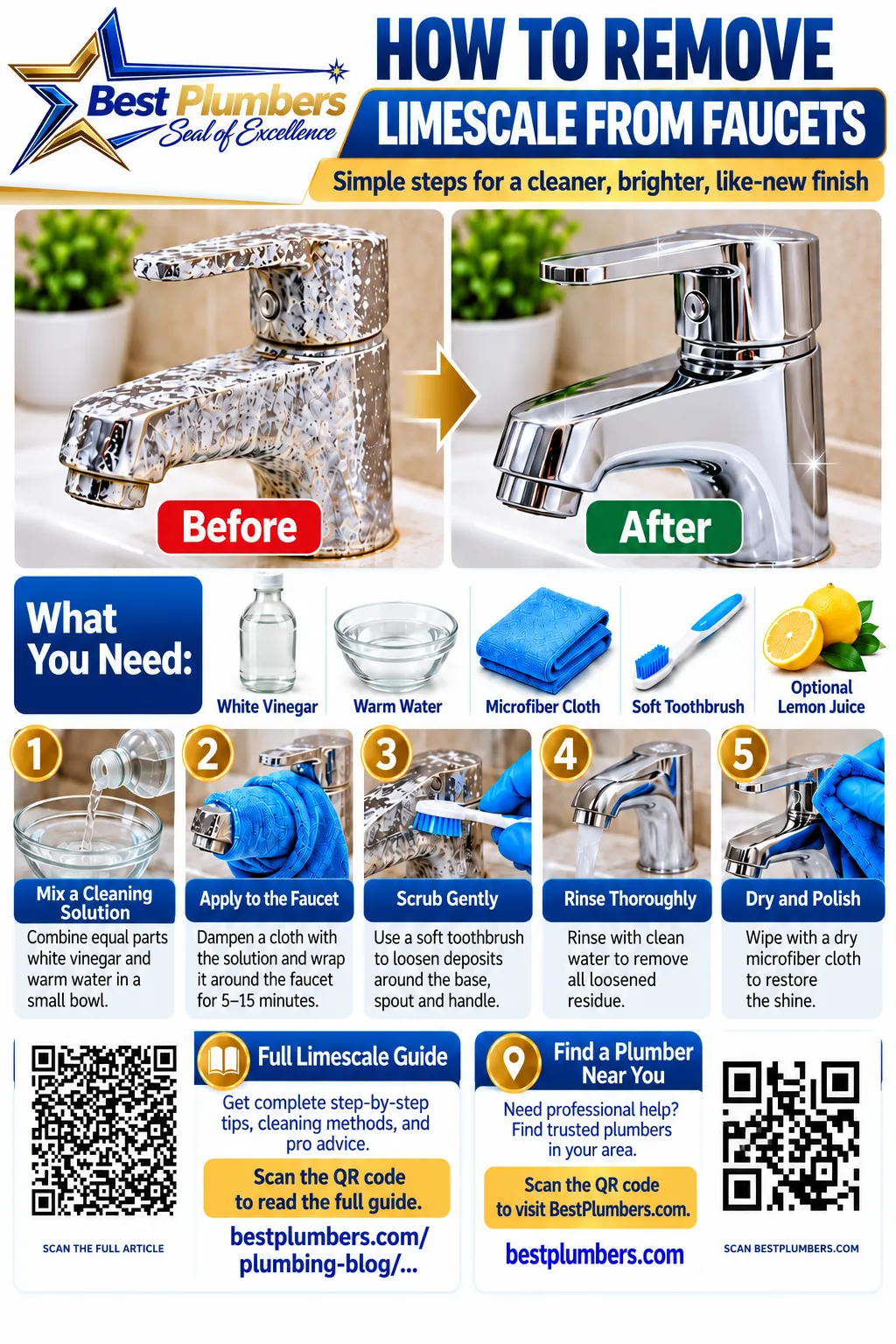 |
What Causes Limescale on Faucets?
Limescale forms when hard water leaves behind dissolved minerals, primarily calcium and magnesium.
As water evaporates from faucets, mineral deposits remain on the surface. Over time, these deposits accumulate and harden, forming the familiar white or gray crust commonly seen around faucet bases, handles, spouts, and aerators.
The problem is especially noticeable in homes supplied by mineral-rich groundwater.
Although limescale itself is generally not a drinking-water health concern, excessive mineral buildup can create problems for plumbing fixtures, household appliances, and water-heating equipment.
For a more detailed explanation, read our comprehensive guide to what limescale is, how it damages your plumbing system, and how to prevent it.
What You Need to Remove Limescale From Faucets
One of the advantages of removing light limescale deposits is that you probably already have the necessary cleaning supplies.
Gather the following materials:
White household vinegar
Warm water
A soft microfiber cloth
An old, soft-bristled toothbrush
A small bowl
A clean towel
Optional: a faucet-safe commercial descaler
White vinegar contains acetic acid, which helps dissolve calcium carbonate deposits.
Important: Before applying vinegar, check your faucet manufacturer's cleaning instructions. Acidic cleaners can damage certain specialty finishes, protective coatings, and surrounding natural-stone countertops.
Never combine vinegar with bleach or chlorine-based cleaning products.
How to Remove Limescale From Faucets in Five Simple Steps
The following method works well for many standard chrome fixtures when the manufacturer permits diluted vinegar.
Step 1: Prepare Your Cleaning Solution
Combine equal parts white vinegar and warm water in a small bowl.
This diluted solution can help break down mineral deposits without requiring harsh scrubbing.
Avoid using boiling water, particularly around plastic components, seals, or temperature-sensitive finishes.
Step 2: Apply the Solution to the Faucet
Dip a clean microfiber cloth into your vinegar solution and gently wrap it around the affected areas.
Pay particular attention to the faucet base, handles, spout, and any locations where white mineral deposits have accumulated.
Allow the damp cloth to remain in contact with the deposits for approximately 5–15 minutes, provided your faucet's finish permits this contact time.
Step 3: Gently Remove the Mineral Deposits
Remove the cloth and examine the softened deposits.
Using a soft-bristled toothbrush, gently work around the faucet base, spout, handles, and crevices.
Avoid steel wool, abrasive pads, metal scrapers, or aggressive brushing. These can scratch or permanently damage faucet finishes.
For stubborn deposits, repeat a manufacturer-approved cleaning treatment rather than increasing the scrubbing pressure.
Step 4: Rinse the Faucet Thoroughly
After loosening the limescale, rinse the faucet with clean water.
Make sure all cleaning solution and loosened mineral residue are removed.
Leaving acidic cleaners on metal surfaces for extended periods can damage certain finishes.
Step 5: Dry and Polish
Finally, use a clean, dry microfiber cloth to wipe away remaining moisture.
Polish the faucet gently until the finish regains its shine.
This final step serves another important purpose: removing water droplets helps prevent fresh mineral deposits from forming as the water evaporates.
Don't Forget the Faucet Aerator
One of the most overlooked places where limescale accumulates is inside the faucet aerator.
The aerator is the small screen or fitting attached to the end of the faucet spout. It helps regulate and distribute water flow.
When mineral deposits clog the aerator, homeowners may experience weak water flow, irregular spray patterns, or splashing.
If your faucet design permits removal, carefully unscrew the aerator, protecting the finish with a soft cloth.
Soak compatible components in vinegar for approximately 30–60 minutes, gently brush away loosened deposits, rinse thoroughly, and reinstall.
If cleaning does not restore normal water flow, the problem may involve a damaged cartridge, obstructed supply line, or another internal component.
In those situations, a qualified plumbing professional specializing in faucet repair services can determine whether cleaning, component replacement, or further plumbing work is necessary.
Why Limescale Is More Than a Cosmetic Problem
A dirty-looking faucet may be the first visible indication of a much larger hard-water problem.
Mineral deposits can also accumulate in hidden areas throughout a plumbing system.
Over time, excessive buildup may:
Restrict water flow through supply lines.
Block faucet aerators and showerhead openings.
Interfere with faucet cartridges and valves.
Reduce the efficiency of water-heating equipment.
Increase maintenance requirements.
Contribute to premature appliance wear.
Water heaters are particularly vulnerable because elevated temperatures encourage calcium carbonate deposits to form.
If your water heater begins rumbling, popping, delivering less hot water, or operating inefficiently, accumulated sediment and mineral scale may be contributing factors.
A qualified water heater repair professional can evaluate the equipment and determine whether flushing, descaling, maintenance, or replacement is appropriate.
How to Prevent Limescale From Returning
Cleaning removes existing deposits, but prevention requires addressing the conditions that allow those deposits to form.
The simplest preventive habit is drying faucets after use.
Other effective measures include regularly cleaning aerators, wiping down showerheads, monitoring water hardness, and maintaining household water-treatment equipment.
For homes with persistent hard-water problems, a properly sized ion-exchange water softener can significantly reduce the mineral content responsible for limescale.
Salt-free water conditioners may also reduce scale adhesion, although they generally do not remove calcium and magnesium from the water.
Homeowners experiencing recurring deposits should consider having their water hardness tested before purchasing treatment equipment.
If an existing softener is no longer controlling mineral buildup, experienced water softener repair and replacement specialists can help identify malfunctioning components, incorrect settings, or equipment that is no longer properly sized for the household.
When Should You Call a Professional Plumber?
Most light surface limescale can be handled through careful household cleaning.
However, certain symptoms suggest that mineral buildup may be affecting more than the visible faucet.
Professional evaluation is advisable when multiple faucets have weak water flow, valves become difficult to operate, leaks develop around fixtures, or mineral deposits repeatedly return despite appropriate water treatment.
An older home with galvanized steel plumbing may also experience internal pipe restrictions caused by accumulated scale and corrosion.
A comprehensive evaluation by experienced plumbing inspection professionals can help identify developing problems before they become expensive repairs.
Protect Your Faucets, Your Plumbing, and Your Investment
Removing limescale from faucets is about more than restoring their appearance.
Regular cleaning helps keep fixtures looking attractive, while proper water treatment and plumbing maintenance can protect the hidden systems that make modern homes comfortable and functional.
The key is recognizing that stubborn mineral deposits are often evidence of an ongoing hard-water condition.
Clean the visible deposits. Investigate recurring problems. Protect the plumbing you cannot see.
Best Plumbers is committed to helping homeowners make informed decisions about plumbing maintenance, water quality, and professional plumbing repairs.
Because taking care of a small plumbing problem today can help prevent a much larger expense tomorrow.
